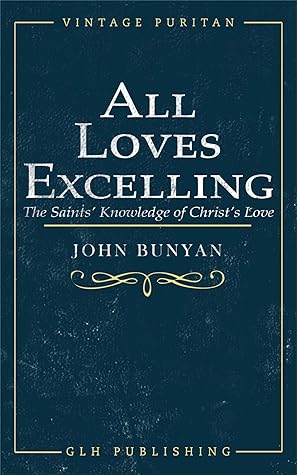
All Loves ExcellingAll Loves Excelling is John Bunyan's sermon on Ephesians 3:17-18, 'That ye ... may be able to comprehend with all saints, what is the breadth, and length, and depth, and height; and to know the love of Christ, which passeth knowledge.' It was first titled 'The Saints' Knowledge of Christ s Love' and is worthy of being ranked alongside Sibbes and deals with a much neglected subject area.
The subject matter of this work which was first preached, is greatly needed today. On the one hand, experiences of the Spirit are being claimed from which the glory of the redeemer and the wonder of his love are quite absent, while on the other, an almost total attention to the understanding and practising of scripture truth is having the effect of marginalising the experiential element in true, spiritual knowledge.
Bunyan's description of Christ's love to believers and how they ought to know it, cuts in both the above-mentioned directions. From some 440 Bible references he shows how knowing Christ's love is the message of Scripture and also the essence of heaven, partly possessed and expressed on earth. Those who know it are rich beyond measure and they are the people who 'sweeten the churches and bring glory to God and to religion'.






















John Bunyan (1628 - 1688)
Was the most famous of the Puritan writers and preachers. He was born at Harrowden (1 mile south-east of Bedford), in the Parish of Elstow, England. He is most well-known for his book “The Pilgrim's Progress”, one of the most printed books in history, which he composed while in prison for the crime of preaching the Gospel without a license.John Bunyan wrote The Pilgrim's Progress in two parts, of which the first appeared at London in 1678,which he had begun during his imprisonment in 1676. The second part appeared in 1684. The earliest edition in which the two parts were combined in one volume came out in 1728. A third part falsely attributed to Bunyan appeared in 1693. The Pilgrim's Progressis the most successful allegory ever written, and like the Bible has been extensively translated into other languages.
John Bunyan was an English Christian writer and preacher, famous for writing The Pilgrim's Progress, arguably the most published book besides the Bible. In the Church of England, he is remembered with a Lesser Festival on 30 August.
He had very little schooling (about 2-4 years). He was educated at his father's house with other poor country boys and what little education he received was to benefit his father and his own future trade.
Bunyan became a popular preacher as well as a prolific author, though most of his works consist of expanded sermons. Though a Baptist preacher, in theology he was a Puritan.
His affinity for the oral tradition and his voracious reading lead to his work being primarily influenced by sermons, homilies in dialog form, folk tales, books of emblems and allegories. "Most of the didactic works of Bunyan's era have vanished into oblivion. His allegory's power derives from the imaginative force with which he brings didactic themes to life and the wonderfully living prose in which he dramatizes the conflicts of the spirit".
Bunyan wrote about 60 books and tracts, of which The Holy War ranks next to The Pilgrim's Progress in popularity. A passage from Part Two of The Pilgrim's Progress beginning "Who would true Valour see" has been used in the hymn "To be a Pilgrim".
The name of John Bunyan is forever linked with the town of Bedford. Bunyan was born in 1628 just outside the village of Elstow, on the outskirts of modern Bedford. His precise birth site is unknown, though it seems likely he was born in a now lost cottage near two fields called "Further Bunyans" and "Bunyans". A plaque on the supposed site of the cottage was erected in 1951.
He was the son of a tinker, and may well have helped his father in that occupation during his youth. Bunyan reported on his own childhood that he loved to play "tip-cat", a form of rounders, on the village green in Elstow.
Bunyan fought in the Civil War on the side of Parliament and when the conflict ended he returned to Elstow and married a local woman who's name was probably Mary. He had four children with his first wife, including a girl who was blind from birth.
It may partly have been this occurrence that led him to question his rowdy lifestyle and search for a deeper sense of meaning in his life. Bunyan began attending a new religious congregation meeting at St. John's Church, Bedford. He became good friends with the pastor, John Gifford.
When Gifford died, Bunyan took his place as head of the congregation, and he travelled the district preaching, generally out of doors. When the Restoration of the monarchy took place in 1660 preaching was forbidden in an attempt to restrain the growth of Independent Congregations. Bunyan refused to stop preaching, and he was arrested in the village of Samsell. He was tried at Bedford Assizes and ordered held in the County Gaol until he agreed to conform.
For the next 12 years Bunyan remained in gaol, in generally poor conditions, though he was allowed visitors and occasionally he was allowed out on what we would today consider "day leave". His second wife Elizabeth appeared before the Lord Chief Justice of England, Matthew Hale, to plead for her husband's release, but her appeal was refused.
Bunyan spent his time in gaol writing a number of books on religious themes, including his biography. Most importantly, he produced the religious allegorical novel, The Pilgrim's Progress, which was eventually published in 1678.
In 1672 Charles II issued his Declaration of Religious Indulgences, and Bunyan, along with other religious offenders, was released from custody. He bought a barn on Mill Street and converted the building to a home for his Independent Congregation.
But in 1673 the king was pressured into repealing his Declaration, and Bunyan was cast back into gaol until 1677.
Bunyan wrote a further 40 books before his death 1n 1688. He is buried in Bunhill Fields, City Road, London.
... Show more