
- Bible
- Read the Bible
- Bible Versions
- Verse of the Day
- Reading Plans
- Verses by Topic
- Books of the Bible
- Bible Images
- Study
- Commentaries
- Concordances
- Dictionaries
- Encyclopedias
- Sermons
- Bible Atlas & Maps
- BP Wiki
- Devotionals
- Today's Devotionals
- Light of the World
- All Devotionals
- Inspirational Quotes
- More
- Picture Quotes
- Videos
- Inspirational
- Bible Study
- What The Bible Says
- Bible Q&As
- Daily Bread
- Bible by Genre
- Bible Stories
- Random Bible Verse
- Community
- Store
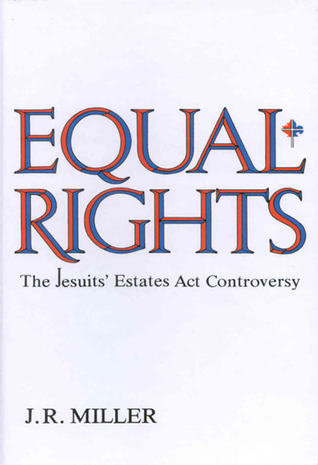
Equal Rights: The Jesuits' Estates ACT Controversy
by J.R. Miller
In the long history of conflict between French and English Canadians, one incident-the controversy over the Jesuits' Estates Act of 1888-has largely been ignored. Yet the agitation occasioned by the Quebec statute compensating the Society of Jesus for the loss of its land after the British Conquest is a significant reflection of political and social developments in Canada in the late nineteenth century. The emotions which the Act produced and which in turn led to assaults upon Roman Catholic education and the French language in Ontario arose from a profound sense of dissatisfaction in parts of the young Dominion. The measure provoked those English Canadians loyal to a particular vision of a British Canadian commonweal and increasingly uneasy about ultra-montane Catholicism, assertive French-Canadian nationalism, political immorality, and adverse social developments in an age of industrialization and urbanization. The organization these English-Canadian assimilationists formed, the Equal Rights Association, had a short life, but the emotions it articulated and amplified increased strains on national unity. Based upon a wide range of manuscript sources and contemporary printed materials, Equal Rights provides the broad context necessary to make sense of the controversy. Its conclusions offer an exciting new insight into Canadian society and politics.
BUY NOW
Hardcover, 240 pages
Published December 12th 2001 by McGill-Queen's University Press (first published January 1979)
Subscribe
Get Bible verse every day in your inbox
Read on Mobile



Group of Brands


















© 2025 Bibleportal.com All rights reserved.
J.R. Miller (1840 - 1912)
Prolific author and pastor of Presbyterian churches in Pennsylvania and Illinois, Rev. James Russell Miller served the USCC as a field agent in the Army of the Potomac and Army of the Cumberland.J.R. Miller began contributing articles to religious papers while at Allegheny Seminary. This continued while he was at the First United, Bethany, and New Broadway churches. In 1875, Miller took over from Henry C. McCook, D.D. when the latter discontinued his weekly articles in The Presbyterian, which was published in Philadelphia. J.R. Miller D.D.'s lasting fame is through his over 50 books. Many are still in publication.
James Russell Miller (March 20, 1840 - July 2, 1912) was a popular Christian author, Editorial Superintendent of the Presbyterian Board of Publication, and pastor of several churches in Pennsylvania and Illinois.
In 1857, James entered Beaver Academy and in 1862 he progressed to Westminster College, Pennsylvania, which he graduated in June, 1862. Then in the autumn of that year he entered the theological seminary of the United Presbyterian Church at Allegheny, Pennsylvania. Mr. Miller resumed his interrupted studies at the Allegheny Theological Seminary in the fall of 1865 and completed them in the spring of 1867. That summer he accepted a call from the First United Presbyterian Church of New Wilmington, Pennsylvania. He was ordained and installed on September 11, 1867.
J.R. Miller began contributing articles to religious papers while at Allegheny Seminary. This continued while he was at the First United, Bethany, and New Broadway churches. In 1875, Miller took over from Henry C. McCook, D.D. when the latter discontinued his weekly articles in The Presbyterian, which was published in Philadelphia.
Five years later, in 1880, Dr. Miller became assistant to the Editorial Secretary at the The Presbyterian Board of Publication, also in Philadelphia.
... Show more