
- Bible
- Read the Bible
- Bible Versions
- Verse of the Day
- Reading Plans
- Verses by Topic
- Books of the Bible
- Bible Images
- Study
- Commentaries
- Concordances
- Dictionaries
- Encyclopedias
- Sermons
- Bible Atlas & Maps
- BP Wiki
- Devotionals
- Today's Devotionals
- Light of the World
- All Devotionals
- Inspirational Quotes
- More
- Picture Quotes
- Videos
- Inspirational
- Bible Study
- What The Bible Says
- Bible Q&As
- Daily Bread
- Bible by Genre
- Bible Stories
- Random Bible Verse
- Community
- Store
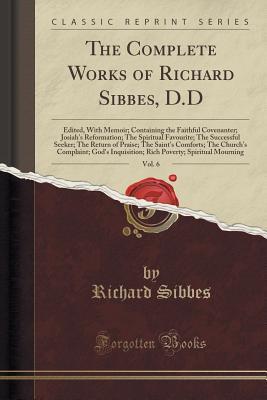
Excerpt from The Complete Works of Richard Sibbes, D.D, Vol. 6: Edited, With Memoir; Containing the Faithful Covenanter; Josiah's Reformation; The Spiritual Favourite; The Successful Seeker; The Return of Praise; The Saint's Comforts; The Church's Complaint; God's Inquisition; Rich Poverty; Spiritual Mourning
When God will afflict or humble a man, it is not a kingdom that will save him.
Tears and mourning for sins, when it comes from inward grief, is a temper befitting any man.
It concerns magistrates above all others to be affected with the dangers and miseries of a land or nation.
It is the duty of every Christian to take to heart the threatenings of God, against that place and people where he doth live.
God takes a particular notice of the prayers we make to him.
About the Publisher
Forgotten Books publishes hundreds of thousands of rare and classic books. Find more at www.forgottenbooks.comwww.forgottenbooks.com
This book is a reproduction of an important historical work. Forgotten Books uses state-of-the-art technology to digitally reconstruct the work, preserving the original format whilst repairing imperfections present in the aged copy. In rare cases, an imperfection in the original, such as a blemish or missing page, may be replicated in our edition. We do, however, repair the vast majority of imperfections successfully; any imperfections that remain are intentionally left to preserve the state of such historical works.
When God will afflict or humble a man, it is not a kingdom that will save him.
Tears and mourning for sins, when it comes from inward grief, is a temper befitting any man.
It concerns magistrates above all others to be affected with the dangers and miseries of a land or nation.
It is the duty of every Christian to take to heart the threatenings of God, against that place and people where he doth live.
God takes a particular notice of the prayers we make to him.
About the Publisher
Forgotten Books publishes hundreds of thousands of rare and classic books. Find more at www.forgottenbooks.comwww.forgottenbooks.com
This book is a reproduction of an important historical work. Forgotten Books uses state-of-the-art technology to digitally reconstruct the work, preserving the original format whilst repairing imperfections present in the aged copy. In rare cases, an imperfection in the original, such as a blemish or missing page, may be replicated in our edition. We do, however, repair the vast majority of imperfections successfully; any imperfections that remain are intentionally left to preserve the state of such historical works.
BUY NOW
Paperback, 576 pages
Published September 22nd 2018 by Forgotten Books
Subscribe
Get Bible verse every day in your inbox
Read on Mobile



Group of Brands


















© 2025 Bibleportal.com All rights reserved.
Richard Sibbes was an English theologian. He is known as a Biblical exegete, and as a representative, with William Perkins and John Preston, of what has been called "main-line" Puritanism.
He attended St John's College, Cambridge from 1595. He was lecturer at Holy Trinity Church, Cambridge, from 1610 or 1611 to 1615 or 1616. It is erroneously held by 18th and 19th century scholars that Sibbes was deprived of his various academic posts on account of his Puritanism. In fact he was never deprived of any of his posts, due to his ingenuity of the system.
He was then preacher at Gray's Inn, London, from 1617, returning to Cambridge as Master of Catherine Hall in 1626, without giving up the London position.
He was the author of several devotional works expressing intense religious feeling -- The Saint's Cordial (1629), The Bruised Reed and Smoking Flax (1631, exegesis of Isaiah 42:3), The Soules Conflict (1635), etc.
... Show more