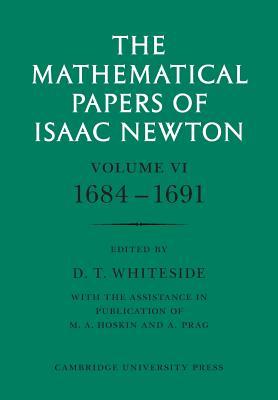
This volume reproduces mathematically significant extracts from the extant manuscript record of Newton's researches during 1684-5 into the dynamical motion of bodies under the deviating action of a central force, and his subsequent struggles thereby to explain the observed motions of solar comets and of the moon. The short tract De motu Corporum, which Newton initially composed on this topic in the early autumn of 1684, was primarily built around his earlier proof that in the absence of external perturbation a planetary eclipse may be traversed under an inverse-square force pull to its solar focus, but also discussed the simplest case of resisted ballistic motion. In epilogue, excerpts from his abandoned grand scheme for revising the Principia in the early 1690s detail Newton's planned refinements to his printed exposition of central force, both simplifying and extending it, introducing therein a novel general fluxional measure of such force - but failing adequately to apply it to the primary case of conic motion.






















Sir Isaac Newton was an English physicist, mathematician, astronomer, natural philosopher, alchemist, and theologian who is considered one of the most influential people in human history.
Newton remains influential to scientists, as demonstrated by a 2005 survey of scientists in Britain's Royal Society asking who had the greater effect on the history of science, Newton or Albert Einstein. Newton was deemed the more influential.[8]
Newton also wrote on Judaeo-Christian prophecy, whose decipherment was essential, he thought, to the understanding of God. His book on the subject, which was reprinted well into the Victorian Age, represented lifelong study. Its message was that Christianity went astray in the 4th century AD, when the first Council of Nicaea propounded erroneous doctrines of the nature of Christ. The full extent of Newton's unorthodoxy was recognized only in the present century: but although a critic of accepted Trinitarian dogmas and the Council of Nicaea, he possessed a deep religious sense, venerated the Bible and accepted its account of creation. In late editions of his scientific works he expressed a strong sense of God's providential role in nature.
... Show more