
Quote by Peter Kreeft

“KANT: The traditional religious foundation for morality may be ontologically stronger, but I say it is not logically or epistemologically stronger. It cannot be proved by speculative, theoretical reason. It cannot be known with certainty. I wanted to construct an absolute and certain ethics; that’s why I confined myself to the parameters of reason alone—and of practical reason alone, for I believe that practical reason can do much more than theoretical reason. I cut down the bushes and weeds of theoretical reason to make room for the garden of practical faith. SOCRATES: So both your structure and your strategy depend on your epistemology of theoretical reason. Your ethics depends on your epistemology. KANT: Yes. We have already established that. SOCRATES: Then I fear it is a beautiful building with a questionable foundation. KANT: That is your final judgment on my work? SOCRATES: Alas, it is. KANT: I have two questions I would like to ask you in conclusion, if they are allowed. SOCRATES: We do not forbid questions here. KANT: You have told me what you think of my philosophy. Can you assure me that God agrees with your judgment on my philosophy? And can you tell me His judgment on me? On how I am known to God? Can you tell me my Heavenly identity? SOCRATES: Can I do these two things? I can answer both of those questions with the same answer. KANT: And the answer is . . . ? SOCRATES: I. Kant.”
Be the first to react on this!



Grupo de Marcas


















© 2025 Bibleportal.com Todos os direitos reservados.
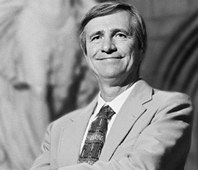
Peter John Kreeft is a professor of philosophy at Boston College and The King's College, and author of numerous books as well as a popular writer on Christian theology, and specifically Roman Catholic apologetics. He also formulated together with Ronald K. Tacelli, SJ, "Twenty Arguments for the Existence of God".
Kreeft took his A.B. at Calvin College (1959), and an M.A. at Fordham University (1961). In the same university he completed his doctoral studies in 1965. He briefly did post graduate studies at Yale University. He joined the Philosophy faculty of the Department of Philosophy of Boston College in 1965. In 1994 he was a signer of the document Evangelicals and Catholics Together.