
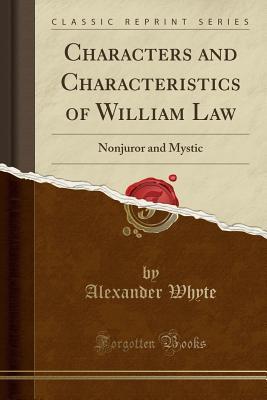
Characters and Characteristics of William Law: Nonjuror and Mystic (Classic Reprint)
by Alexander Whyte
Excerpt from Characters and Characteristics of William Law: Nonjuror and Mystic
The Introductory Lecture stands very much as it was delivered at the opening of my classes for the study of Law this winter.
The Rules and Prayers on pp. 311-328 are from Christopher Walton's Notes and Memorials for a Biography of William Law. (printed for private circulation. London.
About the Publisher
Forgotten Books publishes hundreds of thousands of rare and classic books. Find more at www.forgottenbooks.comwww.forgottenbooks.com
This book is a reproduction of an important historical work. Forgotten Books uses state-of-the-art technology to digitally reconstruct the work, preserving the original format whilst repairing imperfections present in the aged copy. In rare cases, an imperfection in the original, such as a blemish or missing page, may be replicated in our edition. We do, however, repair the vast majority of imperfections successfully; any imperfections that remain are intentionally left to preserve the state of such historical works.
The Introductory Lecture stands very much as it was delivered at the opening of my classes for the study of Law this winter.
The Rules and Prayers on pp. 311-328 are from Christopher Walton's Notes and Memorials for a Biography of William Law. (printed for private circulation. London.
About the Publisher
Forgotten Books publishes hundreds of thousands of rare and classic books. Find more at www.forgottenbooks.comwww.forgottenbooks.com
This book is a reproduction of an important historical work. Forgotten Books uses state-of-the-art technology to digitally reconstruct the work, preserving the original format whilst repairing imperfections present in the aged copy. In rare cases, an imperfection in the original, such as a blemish or missing page, may be replicated in our edition. We do, however, repair the vast majority of imperfections successfully; any imperfections that remain are intentionally left to preserve the state of such historical works.
BUY NOW
Paperback, 386 pages
Published April 22nd 2018 by Forgotten Books (first published September 27th 2015)



品牌集团


















© 2025 Bibleportal.com 版权所有.
Alexander Whyte was a Scottish preacher, with a passion for the lost. He was born at Kirriemuir in Forfarshire and educated at the University of Aberdeen and at New College, Edinburgh.
He entered the ministry of the Free Church of Scotland and after serving as colleague in Free St John's, Glasgow (1866-1870), removed to Edinburgh as colleague and successor to Dr RS Candlish at Free St Georges. In 1909 he succeeded Dr Marcus Dods as principal, and professor of New Testament literature, at New College, Edinburgh.
He will always be remembered for his preaching for no ruler has held his subjects more captive than Alexander Whyte did from his pulpit.
After suffering a heart attack followed by several minor attacks, Whyte resigned his post and retired to Buckinghamshire. There he devoted the remainder of his life to reading and writing. He died January 6, 1921 in his sleep.
Alexander Whyte was a Scottish preacher, with a passion for the lost. He was born at Kirriemuir in Forfarshire and educated at the University of Aberdeen and at New College, Edinburgh.
He entered the ministry of the Free Church of Scotland and after serving as colleague in Free St John's, Glasgow (1866-1870), removed to Edinburgh as colleague and successor to Dr RS Candlish at Free St Georges. In 1909 he succeeded Dr Marcus Dods as principal, and professor of New Testament literature, at New College, Edinburgh.
He will always be remembered for his preaching for no ruler has held his subjects more captive than Alexander Whyte did from his pulpit.
After suffering a heart attack followed by several minor attacks, Whyte resigned his post and retired to Buckinghamshire. There he devoted the remainder of his life to reading and writing. He died January 6, 1921 in his sleep.
... Show more