
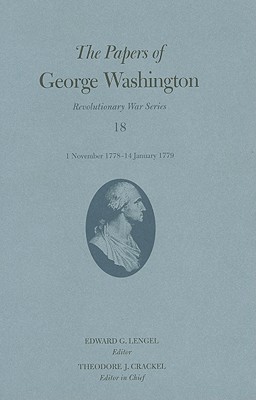
The Papers of George Washington, 18: 1 November 1778-14 January 1779
by George Washington
Volume 18 of the Revolutionary War Series covers the period 1 November 1778 through 14 January 1779. It begins with George Washington at Fredericksburg, New York, watching New York City for signs that the British were about to evacuate North America. The British had very different intentions, however, dispatching the first of several amphibious expeditions to invade and conquer the Deep South. Congress meanwhile mulled plans for the formation of a Franco-American army and the invasion of Canada. Washington worked hard to quash these plans, which he considered both impractical and dangerous. On 11 November, he wrote a long letter to Congress laying out the military reasons why the invasion could never succeed. Three days later, he wrote another, private letter to the President of Congress, warning that a French army in Canada might attempt to reestablish France's North American empire, transforming allies into oppressors. While Congress reconsidered and ultimately scrapped its plans, Washington oversaw the transfer of the captive Convention Army from Boston to Charlottesville, Virginia; planned for the dispersal of his own army to winter cantonments across New Jersey; and rode to Philadelphia in late December to open crucial discussions with Congress about the reorganization of the Continental Army and American strategy for the 1779 campaign.
BUY NOW
Hardcover, 784 pages
Published July 3rd 2008 by University of Virginia Press (first published June 10th 2008)



品牌集团


















© 2025 Bibleportal.com 版权所有.
George Washington was the commander of the Continental Army in the American Revolutionary War (1775-1783) and served as the first President of the United States of America (1789-1797). For his central role in the formation of the United States, he is often referred to as the father of his country.
Washington was baptized into the Church of England. In 1765, when the Church of England was still the state religion, he served on the vestry (lay council) for his local church. Throughout his life, he spoke of the value of righteousness, and of seeking and offering thanks for the "blessings of Heaven."
The Electoral College elected Washington unanimously in 1789, and again in the 1792 election; he remains the only president to receive 100% of the electoral votes.
Washington proved an able administrator. An excellent delegator and judge of talent and character, he held regular cabinet meetings to debate issues before making a final decision. In handling routine tasks, he was "systematic, orderly, energetic, solicitous of the opinion of others but decisive, intent upon general goals and the consistency of particular actions with them.
Washington died in 1799. He has been consistently ranked by scholars as one of the greatest U.S. Presidents.
... Show more