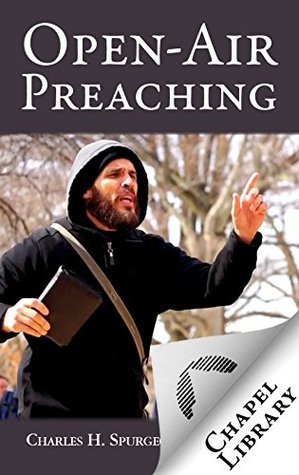
Another quality eBook from Chapel Library. An often overlooked ministry in the church today is that of the open-air preacher. What has open-air preaching looked like over the centuries of church history? And what are some basic principles that we should use in practicing this work today? Spurgeon answers both questions in this fascinating study of open-air preaching.
Open-Air Preaching is adapted from two chapters of Lectures to My Students entitled “Open-Air Preaching and Its History” and “Open-Air Preaching—Remarks Thereon.” Charles H. Spurgeon delivered his Lectures to My Students to men preparing for the ministry at his Pastor’s College. He founded the college to provide a place where men called to preach could study at low cost and with a clear focus on preparation for ministry rather than scholastic achievement.






















C.H. Spurgeon (1834 - 1892)
Spurgeon quickly became known as one of the most influential preachers of his time. Well known for his biblical powerful expositions of scripture and oratory ability. In modern evangelical circles he is stated to be the "Prince of Preachers." He pastored the Metropolitan Tabernacle in downtown London, England.His church was part of a particular baptist church movement and they defended and preached Christ and Him crucified and the purity of the Gospel message. Spurgeon never gave altar calls but always extended the invitation to come to Christ. He was a faithful minister in his time that glorified God and brought many to the living Christ.
Charles Haddon Spurgeon was England's best-known preacher for most of the second half of the nineteenth century. In 1854, just four years after his conversion, Spurgeon, then only 20, became pastor of London's famed New Park Street Church (formerly pastored by the famous Baptist theologian John Gill).
The congregation quickly outgrew their building, moved to Exeter Hall, then to Surrey Music Hall. In these venues Spurgeon frequently preached to audiences numbering more than 10,000 - all in the days before electronic amplification.
In 1861 the congregation moved permanently to the new Metropolitan Tabernacle.
... Show more