
- Bible
- Read the Bible
- Bible Versions
- Verse of the Day
- Reading Plans
- Verses by Topic
- Books of the Bible
- Bible Images
- Study
- Commentaries
- Concordances
- Dictionaries
- Encyclopedias
- Sermons
- Bible Atlas & Maps
- BP Wiki
- Devotionals
- Today's Devotionals
- All Devotionals
- Inspirational Quotes
- More
- Picture Quotes
- Videos
- Inspirational
- Bible Study
- What The Bible Says
- Bible Q&As
- Daily Bread
- Bible by Genre
- Bible Stories
- Random Bible Verse
- Community
- Store
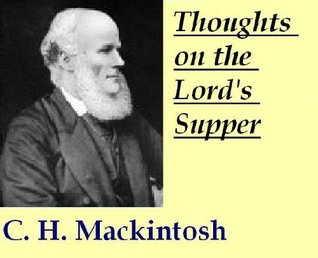
Thoughts on the Lord's Supper
by C.H. Mackintosh
Sub-Title: Designed for the Help of Christians in this Day of Difficulty
Table of Contents
Preface
Thoughts on the Lord's Supper
1. The Nature of the Ordinance of the Lord's Supper
2. The Circumstances under which it was Instituted
3. The Persons for whom it was Designed
4. The Time and Manner of its Observance
The institution of the Lord's Supper must be regarded, by every spiritual man, as a peculiarly touching proof of the Lord's gracious care and considerate love for His Church. From the time of its appointment until the present hour, it has been a steady, though silent, witness to a truth which the enemy, by every means in his power, has sought to corrupt and set aside, namely, that redemption is an accomplished fact to be enjoyed by the weakest believer in Jesus. Eighteen centuries have rolled away since the Lord Jesus appointed “the bread and the cup" in the Eucharist as the significant symbols of His broken body and His blood shed for us; and notwithstanding all the heresy, all the schism, all the controversy and strife, the war of principles and prejudices which the blotted page of ecclesiastical history records, this most expressive institution has been observed by the saints of God in every age. True, the enemy has succeeded throughout a vast section of the professing church in wrapping it up in a shroud of dark superstition—in presenting it in such a way as actually to hide from the view of the communicant the grand and eternal reality of which it is, the memorial—in displacing Christ and His accomplished sacrifice, by a powerless ordinance—an ordinance, moreover, which by the very mode of its administration, proves its utter worthlessness and opposition to the truth. Yet, notwithstanding Rome's deadly error in reference to the ordinance of the Lord's Supper, it still speaks to every circumcised ear, and every spiritual mind, the same deep and precious truth—it “shows the Lord's death till he come." The body has been broken, the blood has been shed ONCE, no more to be repeated: and the breaking of bread is but the memorial of this emancipating truth.
With what profound interest and thankfulness, therefore, should the believer contemplate “the bread and the cup" Without a word spoken, there is the setting forth of truths at once the most precious and glorious—grace reigning—redemption finished—sin put away—everlasting righteousness brought in—the sting of death gone—eternal glory secured—"grace and glory" revealed as the free gift of God and the Lamb—the unity of the "one body," as baptised by “one Spirit." What a feast! it carries the soul back, in the twinkling of an eye, over a lapse of eighteen hundred years, and shows us the Master Himself, “in the same night in which he was betrayed," sitting at the supper table, and there instituting a feast which, from that solemn moment, that memorable night, until the dawn of the morning, should lead every believing heart, at once, backward to the cross, and forward to the glory.
Table of Contents
Preface
Thoughts on the Lord's Supper
1. The Nature of the Ordinance of the Lord's Supper
2. The Circumstances under which it was Instituted
3. The Persons for whom it was Designed
4. The Time and Manner of its Observance
The institution of the Lord's Supper must be regarded, by every spiritual man, as a peculiarly touching proof of the Lord's gracious care and considerate love for His Church. From the time of its appointment until the present hour, it has been a steady, though silent, witness to a truth which the enemy, by every means in his power, has sought to corrupt and set aside, namely, that redemption is an accomplished fact to be enjoyed by the weakest believer in Jesus. Eighteen centuries have rolled away since the Lord Jesus appointed “the bread and the cup" in the Eucharist as the significant symbols of His broken body and His blood shed for us; and notwithstanding all the heresy, all the schism, all the controversy and strife, the war of principles and prejudices which the blotted page of ecclesiastical history records, this most expressive institution has been observed by the saints of God in every age. True, the enemy has succeeded throughout a vast section of the professing church in wrapping it up in a shroud of dark superstition—in presenting it in such a way as actually to hide from the view of the communicant the grand and eternal reality of which it is, the memorial—in displacing Christ and His accomplished sacrifice, by a powerless ordinance—an ordinance, moreover, which by the very mode of its administration, proves its utter worthlessness and opposition to the truth. Yet, notwithstanding Rome's deadly error in reference to the ordinance of the Lord's Supper, it still speaks to every circumcised ear, and every spiritual mind, the same deep and precious truth—it “shows the Lord's death till he come." The body has been broken, the blood has been shed ONCE, no more to be repeated: and the breaking of bread is but the memorial of this emancipating truth.
With what profound interest and thankfulness, therefore, should the believer contemplate “the bread and the cup" Without a word spoken, there is the setting forth of truths at once the most precious and glorious—grace reigning—redemption finished—sin put away—everlasting righteousness brought in—the sting of death gone—eternal glory secured—"grace and glory" revealed as the free gift of God and the Lamb—the unity of the "one body," as baptised by “one Spirit." What a feast! it carries the soul back, in the twinkling of an eye, over a lapse of eighteen hundred years, and shows us the Master Himself, “in the same night in which he was betrayed," sitting at the supper table, and there instituting a feast which, from that solemn moment, that memorable night, until the dawn of the morning, should lead every believing heart, at once, backward to the cross, and forward to the glory.
BUY NOW
Kindle Edition, 29 pages
Published July 10th 2011
Subscribe
Verse of the Day
Get a Bible verse delivered to your inbox every day!
Daily Devotional
Subscribe to receive daily devotionals to help you grow in faith and walk closer with God.
Read on Mobile



Group of Brands


















© 2026 Bibleportal.com All rights reserved.
Charles Henry Mackintosh (1820-1896) was an Irish preacher, Bible expositor, and author. Active in the Irish Revival of 1859-1860. His first tract, in 1843, was "The Peace of God," and his last, shortly before his death in 1896, was "The God of Peace." Generally known as C.H.M., was one of the gifted writers of the Plymouth Brethren, so-called.
He was schoolmaster at Westport, County Mayo, Ireland, for a few years. But for the greater part of his life he devoted himself to evangelism and pastoral ministry as well as to religious journalism, as editor of the monthly periodical Things New and Old; and to religious literature. He was the author of the Notes by C. H. M, on all the books of the Pentateuch, which enjoyed great popularity, being sold in enormous quantity, especially in the United States.
... Show more