
- Bible
- Read the Bible
- Bible Versions
- Verse of the Day
- Reading Plans
- Verses by Topic
- Books of the Bible
- Bible Images
- Study
- Commentaries
- Concordances
- Dictionaries
- Encyclopedias
- Sermons
- Bible Atlas & Maps
- BP Wiki
- Devotionals
- Today's Devotionals
- All Devotionals
- Inspirational Quotes
- More
- Picture Quotes
- Videos
- Inspirational
- Bible Study
- What The Bible Says
- Bible Q&As
- Daily Bread
- Bible by Genre
- Bible Stories
- Random Bible Verse
- Community
- Store
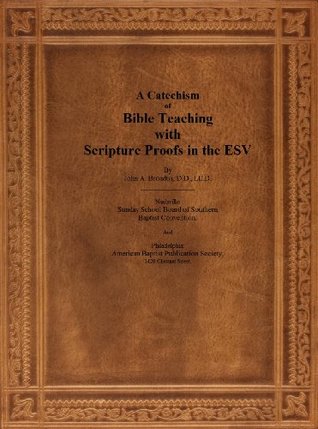
A Catechism of Bible Teaching (Annotated)
by John A. Broadus
• Annotated with Scripture Proofs in the English Standard Version © 2001 (ESV Text 2011 version)
In 1890, feeling the need of a new and somewhat more extended Baptist Catechism than then existed, the American Baptist Publication Society, and the Sunday School Committee (now Sunday School Board) of the Southern Baptist Convention, each at about the same time, asked Dr. John A. Broadus to prepare such a work. At his suggestion it was arranged that the two bodies should unite in the publication. Accordingly, the catechism is now sent forth, having received the sanction of the official committees of both bodies, and by them is commended to their respective constituencies. No one is so well qualified as its honored author to gain a wide hearing in every part of our land, and it is earnestly hoped that the result may be a more thorough acquaintance with the doctrines of God’s Word, and a still greater unity in the faith which that Word inspires.
To each lesson some advanced questions are added in fine print, after the manner of school-books, in order to make the treatment of the subject a little more complete and to meet the inquiries of many youthful minds. These fine-print portions may be learned at first by some classes or individuals, or may be combined with the lessons in reviewing the work; and some teachers will simply explain them after the lesson is recited. The desire has been to present the chief doctrines of the Bible from a devotional and practical point of view; and two or three lessons are introduced of a distinctly practical character. The lessons are arranged on what was thought a natural order, but some of them might be learned without the others, or the order could be varied. Several lessons would need to be divided for many children or classes; and where the catechism is used in connection with the International Series of Scripture lessons, as small number of the questions could be assigned for each Sunday, with constant review. The answers are generally given in terms supposed to be intelligible to children from ten to fifteen years; the technical terms of scientific theology are employed only when indispensable, and usually in such a connection as to throw some light on their meaning. Teachers might help by explaining beforehand any hard word that will occur in the questions or answers if the next lesson.
In 1890, feeling the need of a new and somewhat more extended Baptist Catechism than then existed, the American Baptist Publication Society, and the Sunday School Committee (now Sunday School Board) of the Southern Baptist Convention, each at about the same time, asked Dr. John A. Broadus to prepare such a work. At his suggestion it was arranged that the two bodies should unite in the publication. Accordingly, the catechism is now sent forth, having received the sanction of the official committees of both bodies, and by them is commended to their respective constituencies. No one is so well qualified as its honored author to gain a wide hearing in every part of our land, and it is earnestly hoped that the result may be a more thorough acquaintance with the doctrines of God’s Word, and a still greater unity in the faith which that Word inspires.
To each lesson some advanced questions are added in fine print, after the manner of school-books, in order to make the treatment of the subject a little more complete and to meet the inquiries of many youthful minds. These fine-print portions may be learned at first by some classes or individuals, or may be combined with the lessons in reviewing the work; and some teachers will simply explain them after the lesson is recited. The desire has been to present the chief doctrines of the Bible from a devotional and practical point of view; and two or three lessons are introduced of a distinctly practical character. The lessons are arranged on what was thought a natural order, but some of them might be learned without the others, or the order could be varied. Several lessons would need to be divided for many children or classes; and where the catechism is used in connection with the International Series of Scripture lessons, as small number of the questions could be assigned for each Sunday, with constant review. The answers are generally given in terms supposed to be intelligible to children from ten to fifteen years; the technical terms of scientific theology are employed only when indispensable, and usually in such a connection as to throw some light on their meaning. Teachers might help by explaining beforehand any hard word that will occur in the questions or answers if the next lesson.
BUY NOW
Kindle Edition, 108 pages
Published July 6th 2012
Subscribe
Verse of the Day
Get a Bible verse delivered to your inbox every day!
Daily Devotional
Subscribe to receive daily devotionals to help you grow in faith and walk closer with God.
Read on Mobile



Group of Brands


















© 2026 Bibleportal.com All rights reserved.
John Albert Broadus was an American Baptist pastor and professor at the Southern Baptist Theological Seminary, one of the most famous preachers of his day. Charles Spurgeon deemed Broadus the “greatest of living preachers.” Church historian Albert Henry Newman later said “perhaps the greatest man the Baptists have produced.
Broadus was born in Culpepper County, Virginia, 24 January, 1827. He was educated at the University of Virginia, and from 1851 till 1853 was assistant professor of ancient languages there. He then became pastor of the Baptist church in Charlottesville, and in 1859 professor of New Testament interpretation and homiletics in the Southern Baptist theological seminary at Greenville, South Carolina, now in Louisville, Kentucky As a Greek scholar and New Testament critic.
His quiet conversational delivery brought both critics and imitators. Some men, who equated "real preaching" with soaring in the oratorical stratosphere, accused Broadus of "ruining the preachers of the South" by his example. His students, however, saw his effectiveness and in spite of his warning, many of them tried to imitate his tones, his genuine pathos, his platform manner, failing to realize that they had only a few of his external characteristics and not the qualities of his success.
... Show more