Karl Barth is widely regarded as the most important theologian of the twentieth century, and his observations about the church and its place in a modern world continue to engage religious scholars nearly fifty years after his death. This English translation of the Swiss-published ConversationsConversations is a three-volume collection featuring correspondence, articles, interviews, and other short-form writings by Barth from 1959-1962. Among them are dialogues with representatives of the Evangelical Community Movement (1959); conversations with prison chaplains and a question-and-answer session with the Conference of the World Student Christian Federation (1960); discussions with Methodist preachers, Zurich pastors, and Catholic students of theology (1961); press conferences in New York and Chicago (1962); and an interview at the United Nations (1962). Within these pages, scholars and students will find a comprehensive view into Barth's life and thinking about theology and its role in society today.

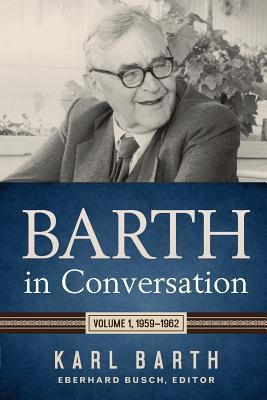





















Karl Barth was a Swiss Reformed theologian whom critics hold to be among the most important Christian thinkers of the 20th century.
Beginning with his experience as a pastor, he rejected his training in the predominant liberal theology typical of 19th-century Protestantism. Instead he embarked on a new theological path initially called dialectical theology, due to its stress on the paradoxical nature of divine truth (e.g., God's relationship to humanity embodies both grace and judgment). Other critics have referred to Barth as the father of neo-orthodoxy -- a term emphatically rejected by Barth himself. The most accurate description of his work might be "a theology of the Word." Barth's theological thought emphasized the sovereignty of God, particularly through his innovative doctrine of election.
Barth tries to recover the Doctrine of the Trinity in theology from its putative loss in liberalism. His argument follows from the idea that God is the object of God's own self-knowledge, and revelation in the Bible means the self-unveiling to humanity of the God who cannot be discovered by humanity simply through its own efforts.
... Show more