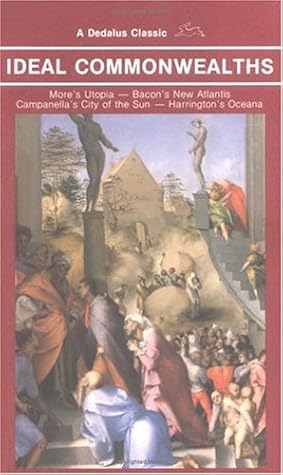
In Lycurgus Plutarch recounts the life of Sparta's legendary founder Lycurgus and the evolution of Spartan political and social institutions. Sir Thomas More's Utopia is the sixteenth-century classic of a patriarchal island kingdom that practiced religious tolerance, in which everybody worked, all goods were community-owned, and violence, bloodshed, and vice were nonexistent. Francis Bacon's New Atlantis, paints "his Ideal Commonwealth in those seas where a great Austral continent was even then supposed to be, but had not been discovered. As the old Atlantis implied a foreboding of the American continent, so the New Atlantis implied foreboding of the Australian. Bacon in his philosophy sought through experimental science the dominion of men over things, "for Nature is only governed by obeying her." In his Ideal World of the New Atlantis, Science is made the civilizer who binds man to man, and is his leader to the love of God. Thomas Campanella urged that Nature should be studied through her own works, not through books. Campanella strenuously urged that men should reform all sciences by following Nature and the books of God. Mundus alter et idem is Joseph Hall's satirical utopian fantasy and description of London, with some criticism of the Catholic church. The narrator takes a voyage in the ship Fantasia, in the southern seas, visiting the lands of Crapulia, Viraginia, Moronia and Lavernia populated by gluttons, nags, fools and thieves respectively.






















Sir Francis Bacon, 1st Viscount St Alban KC, son of Nicholas Bacon by his second wife Anne (Cooke) Bacon, was an English philosopher, statesman, scientist, lawyer, jurist, and author. He served both as Attorney General and Lord Chancellor of England. Although his political career ended in disgrace, he remained extremely influential through his works, especially as philosophical advocate and practitioner of the scientific revolution. Bacon was knighted in 1603, created Baron Verulam in 1618, and Viscount St Alban in 1621.
There are some scholars who believe that Bacon's vision for a Utopian New World in North America was laid out in his novel The New Atlantis, which depicts a mythical island, Bensalem, in the Pacific Ocean west of Peru. He envisioned a land where there would be greater rights for women, the abolishing of slavery, elimination of debtors' prisons, separation of church and state, and freedom of religious and political expression. Francis Bacon played a leading role in creating the British colonies, especially in Virginia, the Carolinas, and Newfoundland.
Thomas Jefferson considered Francis Bacon to be one of the three greatest men who ever lived, "Bacon, Locke and Newton" were "the three greatest men that have ever lived, without any exception." Francis Bacon's influence can also be seen on a variety of religious and spiritual authors, and on groups that have utilized his writings in their own belief systems.
... Show more