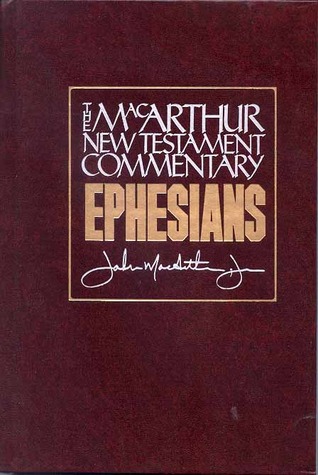
Ephesians has rightly been titled "the believer's bank" and "the treasure house of the Bible." This beautiful letter tells Christians of their great riches, inheritance, and fullness in Jesus Christ and in His church.
Join John MacArthur as he explains each verse in a way that is both doctrinally precise and intensely practical. Taking into account the cultural, theological, and Old Testament contexts of each passage, MacArthur tackles interpretive challenges and fairly evaluates differing views, giving the reader confidence in his conclusions.
The MacArthur New Testament Commentary series comes from the experience, wisdom, and insight of one of the most trusted ministry leaders and Bible scholars of our day. Each volume was written to be as comprehensive and accurate as possible, dealing thoroughly with every key phrase and word in the Scripture without being unnecessarily technical. This commentary will help to give a better, fuller, richer understanding of God's Word, while challenging the reader to a vibrant personal spiritual walk.
A great resource for pastors, teachers, leaders, students, or anyone desiring to dig deeper into ScriptureA great resource for pastors, teachers, leaders, students, or anyone desiring to dig deeper into Scripture






















John F. MacArthur, Jr. is a fifth-generation preacher who serves as a pastor-teacher of Grace Community Church in Sun Valley, California. He is also a prolific author, conference speaker, and is president of The Master's College and Seminary. MacArthur received a B.A. from Los Angeles Pacific College, his M.Div. from Talbot Theological Seminary, Litt.D. at Grace Graduate School, and D.D. from Talbot Theological Seminary. In addition to his administrative responsibilities, he regularly teaches Expository Preaching at the seminary and frequently speaks in chapel.
MacArthur's pulpit ministry has been extended around the globe through his media ministry, Grace to You, and its satellite offices in Australia, Canada, Europe, India, New Zealand, Singapore, and South Africa. In addition to producing daily radio programs for nearly 2,000 English and Spanish radio outlets worldwide, Grace to You distributes books, software, audiotapes, and CDs by John MacArthur. In thirty-six years of ministry, Grace to You has distributed more than thirteen million CDs and audiotapes.
John Fullerton MacArthur, Jr. is a United States evangelical writer and minister, noted for his radio program entitled Grace to You. MacArthur is a fifth-generation pastor, a popular author and conference speaker and has served as the pastor-teacher of Grace Community Church in Sun Valley, California since 1969, and as the President of The Master's College (and the related The Master's Seminary) in Santa Clarita, California.
Theologically, MacArthur is a conservative far-right Baptist, a strong proponent of expository preaching, a dispensationalist and a self-described Calvinist. He has been acknowledged by Christianity Today as one of the most influential preachers of his time, and is a frequent guest on Larry King Live as representative of an evangelical Christian perspective.
MacArthur has authored or edited more than 150 books, most notably the MacArthur Study Bible, which has sold more than 1 million copies and received a Gold Medallion Book Award. Other best-selling books include his MacArthur New Testament Commentary Series (more than 1 million copies), Twelve Ordinary Men, (more than 500,000 copies), and the children's book A Faith to Grow On, which garnered an ECPA Christian Book Award.
... Show more