THE EXPANSIVE COMMENTARY COLLECTION is a new release of much loved and oft used commentaries.
Each commentary is beautifully formatted with every verse given an uncluttered presentation for ease of reference and use. We have taken great care to provide you with each individual commentary as it was intended and written by the original author.
Our commentaries are equipped with the very best active tables of contents that drill down from the main contents page to the individual Bible book, to the author, to the Bible book chapter and then to the very verse you are looking to study. These tables of contents have been designed for ease of use and to get you to the exact verse you are looking at.
In this volume we give you Albert Barnes’ commentary on Paul’s Epistle to the Ephesians.
Albert Barnes (1798-1870) was a distinguished theologian from New York State, USA. In addition to his studies he was an ordained Presbyterian Minister and pastored Churches in New Jersey and Philadelphia.
As a commentary the value of Albert Barnes’ contribution must not be underestimated. His writing is doctrinal but not dogmatic. He shines new light on various passages but all the time remaining true to the biblical meaning.

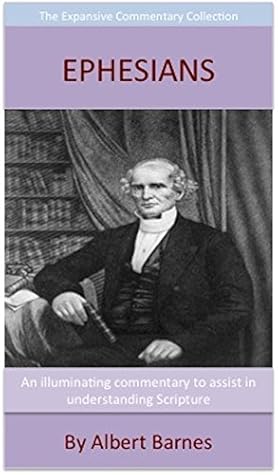





















Albert Barnes was an American theologian, born at Rome, New York, on December 1, 1798. He graduated from Hamilton College, Clinton, New York, in 1820, and from Princeton Theological Seminary in 1823. Barnes was ordained as a Presbyterian minister by the presbytery of Elizabethtown, New Jersey, in 1825, and was the pastor successively of the Presbyterian Church in Morristown, New Jersey (1825-1830), and of the First Presbyterian Church of Philadelphia (1830-1867).
He was an eloquent preacher, but his reputation rests chiefly on his expository works, which are said to have had a larger circulation both in Europe and America than any others of their class.
Of the well-known Notes on the New Testament, it is said that more than a million volumes had been issued by 1870. The Notes on Job, the Psalms, Isaiah and Daniel found scarcely less acceptance. Displaying no original critical power, their chief merit lies in the fact that they bring in a popular (but not always accurate) form the results of the criticism of others within the reach of general readers. Barnes was the author of several other works of a practical and devotional kind, including Scriptural Views of Slavery (1846) and The Way of Salvation (1863). A collection of his Theological Works was published in Philadelphia in 1875.
... Show more