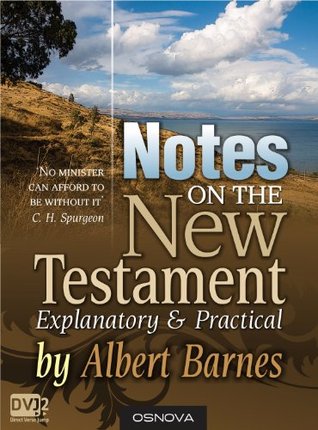
The best-selling Notes on the New Testament were written over a number of years in 11 volumes by the 19th century American theologian Albert Barnes. They contain evangalical verse-by-verse explanation of the Bible using the King James translation. Charles Spurgeon said of this commentary, "No minister can afford to be without it."
This OSNOVA Kindle edition contains complete and unabridged text of the Notes in one electronic publication, which is made easy to navigate via a Direct Verse Jump (DVJ) method, an active table of contents, and a cross-reference system between the Notes and the included Bible.
The DVJ works both for the Bible and the Notes, making it easy to open any Bible verse or Notes passage. There are also other navigational aids, described in detail at the beginning of the book. We highly recommend that you take time to read the instructions on how to use this excellent study tool effectively before you dig into the book!
DISCLAIMER: Not all features of this publications are supported on Kindle applications (e.g., Kindle for iPhone, iPad, or PC) or some Kindle models (e.g. original Kindle Fire). This is a limitation imposed by software developed by Amazon and is out of our control.
If you have any questions or concern please email us first at osnova@gmail.com. We want to provide the best service and receive five-star reviews from you!






















Albert Barnes was an American theologian, born at Rome, New York, on December 1, 1798. He graduated from Hamilton College, Clinton, New York, in 1820, and from Princeton Theological Seminary in 1823. Barnes was ordained as a Presbyterian minister by the presbytery of Elizabethtown, New Jersey, in 1825, and was the pastor successively of the Presbyterian Church in Morristown, New Jersey (1825-1830), and of the First Presbyterian Church of Philadelphia (1830-1867).
He was an eloquent preacher, but his reputation rests chiefly on his expository works, which are said to have had a larger circulation both in Europe and America than any others of their class.
Of the well-known Notes on the New Testament, it is said that more than a million volumes had been issued by 1870. The Notes on Job, the Psalms, Isaiah and Daniel found scarcely less acceptance. Displaying no original critical power, their chief merit lies in the fact that they bring in a popular (but not always accurate) form the results of the criticism of others within the reach of general readers. Barnes was the author of several other works of a practical and devotional kind, including Scriptural Views of Slavery (1846) and The Way of Salvation (1863). A collection of his Theological Works was published in Philadelphia in 1875.
... Show more