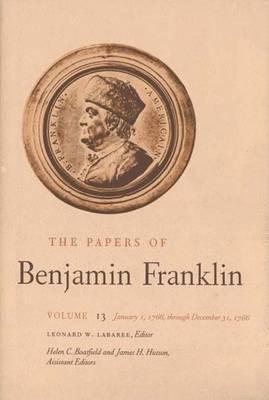
The most important event in Franklin's career during 1766 was his influential examination before the House of Commons advocating the repeal of the Stamp Act. The verbatim account of that examination, as recorded by the assistant clerk, is reprinted here. Included are notations by Franklin and one of the members as to who asked the various questions to which he address his remarks.His other activities as colonial agent relating to the Stamp Act and the act restraining paper money are indicated in both his personal correspondence and his letter to English newspapers.Early in 1766, Franklin's printing partnership with David Hall expired; the final accounts of this venture reveal much about the activities of one of the major printing and publishing firms in the colonies.During the summer Franklin accompanied an English friend on a trip through Germany. In what must have been a series of interviews, one scholar drew from him extended information about America, which was later printed in a Hanoverian journal. This report, reprinted here, appears for the first time in a complete English translation.Mr. Labaree is Farnam Professor Emeritus of History at Yale University.






















Benjamin Franklin was an important conservative figure in the American Restoration Movement, especially as the leading antebellum conservative in the northern United States branch of the movement. He is notable as the early and lifelong mentor of Daniel Sommer, whose support of the 1889 Sand Creek Declaration set in motion events which led to the formal division of the Churches of Christ from the Disciples of Christ in 1906.
According to contemporary biographies "His early religious training was according to the Methodist faith, though he never belonged to any church until he united with the Disciples."
In 1856, Franklin began to publish the ultra-conservative American Christian Review, which he published until his death in 1878. Its influence, initially considerable, was said to have waned following the American Civil War. Franklin undertook a rigorous program of publication correspondence, and traveling lectures which took him to "many" U. S. states and Canada.
Franklin's last move was to Anderson, Indiana, where he lived from 1864 until his death.
... Show more