この本は、ブレーズ・パスカルの主著「パンセ」などから、訳者津田穣(つだゆたか)が抜粋編集したものを元に作成しました。
著者ブレーズ・パスカルの生没年は、一六二三年—一六六一年、
訳者津田穣の生没年は、一九一〇年—一九五五年、
となっていますので、この本はパブリックドメインとなっています。なお、巻末に訳者による解説があります。
この古典教養文庫版の「パスカルの言葉」には次のような特長があります。
1、原訳書の注は、ほぼそのまま各節末に、二段階小さい文字で掲載しました。
2、わかりにくい言葉や、登場人物、でき事、作品などについての適切な注を、編集者が割り注の形で入れましたので、本文の理解が深まります。
3、人名・地名は、現在通常に使われている表記に変更しました。
なお、各断章に表題がないものについては、「一 邪悪な人とは……」のように、各節の最初の何語かを取り表題の代わりとしました。目次から内容がすぐに類推できるようするためです。表題にこの「……」がないものは、パスカル自身がつけた表題です。
また、訳注の中の「B印」とは、ブロンシュヴィック版の読み方に従うしるしであり、同じくT印をつけたところはトゥルヌール版の読み方に従うことを意味します。
またこの本の底本は以下のとおりです。
「パスカルの言葉」 アテネ文庫(弘文堂)
昭和二十六年一月二十五日 初版印刷
昭和二十六年一月 三十日 初版発行

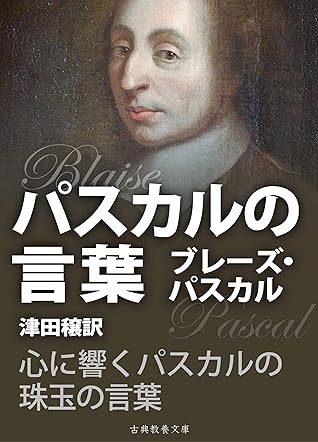





















Among the contemporaries of Descartes none displayed greater natural genius than Pascal, but his mathematical reputation rests more on what he might have done than on what he actually effected, as during a considerable part of his life he deemed it his duty to devote his whole time to religious exercises.
At 16, Pascal began designing a calculating machine, which he finally perfected when he was thirty, the pascaline, a beautiful handcrafted box about fourteen by five by three inches. The first accurate mechanical calculator was born.
Pascal was dismayed and disgusted by society's reactions to his machine and completely renounced his interest in science an mathematics, devoting the rest of his life to God. He is best known for his collection of spiritual essays, Les Pensees.
Ironically, Pascal, who was a genius by any measure, with one of the finest brains of all time, died of a brain hemorrhage at the age of 39.
Among the contemporaries of Descartes none displayed greater natural genius than Pascal, but his mathematical reputation rests more on what he might have done than on what he actually effected, as during a considerable part of his life he deemed it his duty to devote his whole time to religious exercises.
He was a child prodigy who was educated by his father, a Tax Collector in Rouen. Pascal's earliest work was in the natural and applied sciences where he made important contributions to the study of fluids, and clarified the concepts of pressure and vacuum by generalizing the work of Evangelista Torricelli.
In 1646, he and his sister Jacqueline identified with the religious movement within Catholicism known by its detractors as Jansenism. Following a mystical experience in late 1654, he had his "second conversion", abandoned his scientific work, and devoted himself to philosophy and theology. His two most famous works date from this period: the Lettres provinciales and the Pensees.
In honor of his scientific contributions, the name Pascal has been given to the SI unit of pressure, to a programming language, and Pascal's law (an important principle of hydrostatics), and as mentioned above, Pascal's triangle and Pascal's wager still bear his name.
... Show more