
- Bible
- Read the Bible
- Bible Versions
- Verse of the Day
- Reading Plans
- Verses by Topic
- Books of the Bible
- Bible Images
- Study
- Commentaries
- Concordances
- Dictionaries
- Encyclopedias
- Sermons
- Bible Atlas & Maps
- BP Wiki
- Devotionals
- Today's Devotionals
- All Devotionals
- Inspirational Quotes
- More
- Picture Quotes
- Videos
- Inspirational
- Bible Study
- What The Bible Says
- Bible Q&As
- Daily Bread
- Bible by Genre
- Bible Stories
- Random Bible Verse
- Community
- Store
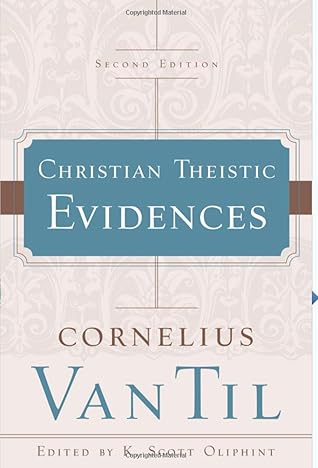
Christian Theistic Evidences
by Cornelius Van Til
hristian-Theistic Evidences may not be the catchiest title for an apologetics text, but readers who have digested Van Til's revolutionary insights will understand that it carries a profound double-meaning. Not only are there abundant evidences for the truth of Christian theism, the very idea of 'evidences' presupposes the truth of Christian theism. Evidences are, by nature, Christian theistic. If the sovereign God of the Bible exists, they can be nothing less. No one has pressed this point with more conviction than Van Til. I'm immensely grateful to P&R for issuing these new editions of Van Til's major works with insightful editorial annotations by Scott Oliphint and William Edgar.--James Anderson, (Sept. 30)
Critics of Cornelius Van Til often complained that in Van Til's presuppositionalist apologetics there was no room for the use of evidences to verify the Christian faith. But Van Til often said that evidences were an important part of apologetics. In fact, he taught a required course on Christian Evidences at Westminster Theological Seminary. Now the textbook for that course is available again, Christian Theistic Evidences, in a new edition with introduction and new footnotes by Scott Oliphint of Westminster, who has produced recent editions of other Van Til works. Christian Theistic Evidences is Van Til's philosophy of fact, his philosophy of science, and as such it should interest everyone who seeks to understand Van Til's work.--John Frame
Does the defense of the faith require evidences? Absolutely, as long as they are accounted for within the biblical worldview. Christian Theistic Evidences deserves to be better-known than it is. Historically, it represents Cornelius Van Til's first, revolutionary statement of presuppositional (or covenantal) apologetics. It contains all of his major statements against the pretended neutrality of fact, of reason, and of foundations. Dr. Oliphint's masterful annotations clarify and enhance the beauty of the text. His Introduction is pure gold. This is must reading for anyone who wishes apologetic method to be consistent with sound theology.--William Edgar, Professor of Apologetics, Westminster Theological Seminary
There is no greater misconception about the presuppositional epistemology of Van Til than that it has no place for offering evidences for the truth of Christianity. There is no more important recognition about this epistemology, rooted in Scripture as the self-attesting revelation of the Triune God essential for interpreting the whole of reality, than that it provides the only sound basis for a truly compelling presentation of the manifold evidence there is. The value of this seminally important work is greatly enhanced by Oliphint's Forward and his editorial comments throughout.--Richard B. Gaffin Jr., Professor of Biblical and Systematic Theology, Emeritus, Westminster Theological Seminary
From the Back Cover
Can we effectively defend the primary authority of Scripture if we start our defense by turning to other sources? In Christian Theistic Evidences, Cornelius Van Til argues for the defense of a pure, full-fledged Christianity, unadulterated by a scientific methodology founded on non-Christian assumptions. He offers us instead a Christian philosophy and methodology for defending the faith that presupposes the absolute authority of the triune God of Scripture. This retypeset work, originally from Van Til's famous Christian Evidences class at Westminster Seminary, includes a foreword and explanatory notes from K. Scott Oliphint.
About the Author
Cornelius Van Til (1895-1987) was born in Grootegast, the Netherlands, and immigrated with his family to America in 1905. He attended Calvin College and Calvin Seminary before completing his studies at Princeton Theological Seminary and Princeton University with the ThM and PhD degrees. Drawn to the pastorate, Van Til spent one year in the ministry before taking a leave of absence to teach apologetics at Princeton Seminary. When the seminary reorganized, he was persuaded to join the faculty of the newly founded Westminster Theological Seminary. He remained there as professor of apologetics until his retirement in 1972. Van Til wrote more than twenty books, in addition to more than thirty syllabi. Among his best-known titles are The Defense of the Faith, A Christian Theory of Knowledge, and An Introduction to Systematic Theology.
Critics of Cornelius Van Til often complained that in Van Til's presuppositionalist apologetics there was no room for the use of evidences to verify the Christian faith. But Van Til often said that evidences were an important part of apologetics. In fact, he taught a required course on Christian Evidences at Westminster Theological Seminary. Now the textbook for that course is available again, Christian Theistic Evidences, in a new edition with introduction and new footnotes by Scott Oliphint of Westminster, who has produced recent editions of other Van Til works. Christian Theistic Evidences is Van Til's philosophy of fact, his philosophy of science, and as such it should interest everyone who seeks to understand Van Til's work.--John Frame
Does the defense of the faith require evidences? Absolutely, as long as they are accounted for within the biblical worldview. Christian Theistic Evidences deserves to be better-known than it is. Historically, it represents Cornelius Van Til's first, revolutionary statement of presuppositional (or covenantal) apologetics. It contains all of his major statements against the pretended neutrality of fact, of reason, and of foundations. Dr. Oliphint's masterful annotations clarify and enhance the beauty of the text. His Introduction is pure gold. This is must reading for anyone who wishes apologetic method to be consistent with sound theology.--William Edgar, Professor of Apologetics, Westminster Theological Seminary
There is no greater misconception about the presuppositional epistemology of Van Til than that it has no place for offering evidences for the truth of Christianity. There is no more important recognition about this epistemology, rooted in Scripture as the self-attesting revelation of the Triune God essential for interpreting the whole of reality, than that it provides the only sound basis for a truly compelling presentation of the manifold evidence there is. The value of this seminally important work is greatly enhanced by Oliphint's Forward and his editorial comments throughout.--Richard B. Gaffin Jr., Professor of Biblical and Systematic Theology, Emeritus, Westminster Theological Seminary
From the Back Cover
Can we effectively defend the primary authority of Scripture if we start our defense by turning to other sources? In Christian Theistic Evidences, Cornelius Van Til argues for the defense of a pure, full-fledged Christianity, unadulterated by a scientific methodology founded on non-Christian assumptions. He offers us instead a Christian philosophy and methodology for defending the faith that presupposes the absolute authority of the triune God of Scripture. This retypeset work, originally from Van Til's famous Christian Evidences class at Westminster Seminary, includes a foreword and explanatory notes from K. Scott Oliphint.
About the Author
Cornelius Van Til (1895-1987) was born in Grootegast, the Netherlands, and immigrated with his family to America in 1905. He attended Calvin College and Calvin Seminary before completing his studies at Princeton Theological Seminary and Princeton University with the ThM and PhD degrees. Drawn to the pastorate, Van Til spent one year in the ministry before taking a leave of absence to teach apologetics at Princeton Seminary. When the seminary reorganized, he was persuaded to join the faculty of the newly founded Westminster Theological Seminary. He remained there as professor of apologetics until his retirement in 1972. Van Til wrote more than twenty books, in addition to more than thirty syllabi. Among his best-known titles are The Defense of the Faith, A Christian Theory of Knowledge, and An Introduction to Systematic Theology.
BUY NOW
288 pages
Subscribe
Verse of the Day
Get a Bible verse delivered to your inbox every day!
Daily Devotional
Subscribe to receive daily devotionals to help you grow in faith and walk closer with God.
Read on Mobile



Group of Brands


















© 2026 Bibleportal.com All rights reserved.
Cornelius Van Til was a Dutch-American Calvinist philosopher and theologian, who is credited as being the originator of modern presuppositional apologetics.
... Show more