
- Bible
- Read the Bible
- Bible Versions
- Verse of the Day
- Reading Plans
- Verses by Topic
- Books of the Bible
- Bible Images
- Study
- Commentaries
- Concordances
- Dictionaries
- Encyclopedias
- Sermons
- Bible Atlas & Maps
- BP Wiki
- Devotionals
- Today's Devotionals
- Light of the World
- All Devotionals
- Inspirational Quotes
- More
- Picture Quotes
- Videos
- Inspirational
- Bible Study
- What The Bible Says
- Bible Q&As
- Daily Bread
- Bible by Genre
- Bible Stories
- Random Bible Verse
- Community
- Store
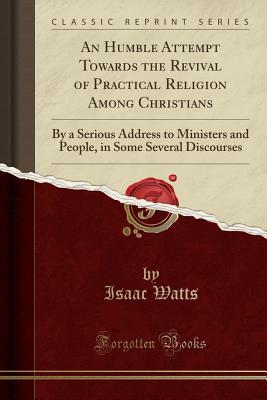
Excerpt from An Humble Attempt Towards the Revival of Practical Religion Among Christians: By a Serious Address to Ministers and People, in Some Several Discourses
But the Providence of God prevented me from fulfilling tloat Service by confining me to a Bed of Sicbnefs on tloat Day. In tloe C ompofition of tbat Difcourfe my Tbouglots ran out to four or five Times tbe Lengtb of wloat would bave been fufieient for tbat Service, [0 tbat I ma]? Loave greatly contratted it in tbe Delivery r But being mucb importuned bot/o by my Reverend Brat/oer, wao bas perufizd far tbe greate/t Part of it, and by tloe Congregation now under lois Care, to malee it publicle, I bave revifed it wit/o a larger View, and loumbly loope tloat my younger Bretbren in tbe Mini/try may be in fome Meafure excited and encouraged bereby to do tbeir Part toward tbc Revival of decaying Piety. 't is exprejsly wita tbis View and De/ign, tbat my wortby Friend Mr. David Some in Leiceflzeri'hire publi/loed an excellent Sermon la/t 2 ear, tae Perufal wbereof I would beartily recommend to all my Bretbren.
About the Publisher
Forgotten Books publishes hundreds of thousands of rare and classic books. Find more at www.forgottenbooks.comwww.forgottenbooks.com
This book is a reproduction of an important historical work. Forgotten Books uses state-of-the-art technology to digitally reconstruct the work, preserving the original format whilst repairing imperfections present in the aged copy. In rare cases, an imperfection in the original, such as a blemish or missing page, may be replicated in our edition. We do, however, repair the vast majority of imperfections successfully; any imperfections that remain are intentionally left to preserve the state of such historical works.
But the Providence of God prevented me from fulfilling tloat Service by confining me to a Bed of Sicbnefs on tloat Day. In tloe C ompofition of tbat Difcourfe my Tbouglots ran out to four or five Times tbe Lengtb of wloat would bave been fufieient for tbat Service, [0 tbat I ma]? Loave greatly contratted it in tbe Delivery r But being mucb importuned bot/o by my Reverend Brat/oer, wao bas perufizd far tbe greate/t Part of it, and by tloe Congregation now under lois Care, to malee it publicle, I bave revifed it wit/o a larger View, and loumbly loope tloat my younger Bretbren in tbe Mini/try may be in fome Meafure excited and encouraged bereby to do tbeir Part toward tbc Revival of decaying Piety. 't is exprejsly wita tbis View and De/ign, tbat my wortby Friend Mr. David Some in Leiceflzeri'hire publi/loed an excellent Sermon la/t 2 ear, tae Perufal wbereof I would beartily recommend to all my Bretbren.
About the Publisher
Forgotten Books publishes hundreds of thousands of rare and classic books. Find more at www.forgottenbooks.comwww.forgottenbooks.com
This book is a reproduction of an important historical work. Forgotten Books uses state-of-the-art technology to digitally reconstruct the work, preserving the original format whilst repairing imperfections present in the aged copy. In rare cases, an imperfection in the original, such as a blemish or missing page, may be replicated in our edition. We do, however, repair the vast majority of imperfections successfully; any imperfections that remain are intentionally left to preserve the state of such historical works.
BUY NOW
Paperback, 306 pages
Published August 2nd 2018 by Forgotten Books
Subscribe
Get Bible verse every day in your inbox
Read on Mobile



Group of Brands


















© 2025 Bibleportal.com All rights reserved.
Isaac Watts is recognised as the "Father of English Hymnody", as he was the first prolific and popular English hymnwriter, credited with some 750 hymns. Many of his hymns remain in active use today and have been translated into many languages.
His education led him to the pastorate of a large Independent Chapel in London, and he also found himself in the position of helping trainee preachers, despite poor health. Taking work as a private tutor, he lived with the non-conformist Hartopp family at Fleetwood House, Abney Park in Stoke Newington, and later in the household of Sir Thomas Abney and Lady Mary Abney at Theobalds, Cheshunt, in Hertfordshire, and at their second residence, Abney House, Stoke Newington.
Though a non-conformist, Sir Thomas practised occasional conformity to the Church of England as necessitated by his being Lord Mayor of London 1700-01. Likewise, Isaac Watts held religious opinions that were more non-denominational or ecumenical than was at that time common for a non-conformist, having a greater interest in promoting education and scholarship, than preaching for any particular ministry.
... Show more