
- Bible
- Read the Bible
- Bible Versions
- Verse of the Day
- Reading Plans
- Verses by Topic
- Books of the Bible
- Bible Images
- Study
- Commentaries
- Concordances
- Dictionaries
- Encyclopedias
- Sermons
- Bible Atlas & Maps
- BP Wiki
- Devotionals
- Today's Devotionals
- Light of the World
- All Devotionals
- Inspirational Quotes
- More
- Picture Quotes
- Videos
- Inspirational
- Bible Study
- What The Bible Says
- Bible Q&As
- Daily Bread
- Bible by Genre
- Bible Stories
- Random Bible Verse
- Community
- Store
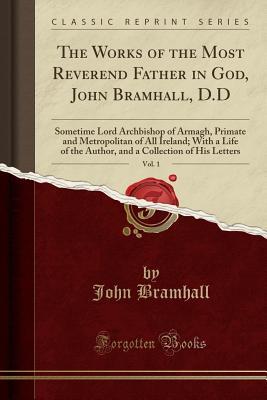
Excerpt from The Works of the Most Reverend Father in God, John Bramhall, D.D, Vol. 1: Sometime Lord Archbishop of Armagh, Primate and Metropolitan of All Ireland; With a Life of the Author, and a Collection of His Letters
The quotations in the text of the treatises themselves, where they are verbally exact or nearly so, are marked with double commas; where such exactness does not exist, with single commas.
The orthography (with the exception of a few words d, where it seemed worth while to preserve a peculiar or characteristic mode of spelling) has been throughout modernised (excepting of course in the Letters, mentioned below); as there appeared to be little in it in general either to mark the style of the author or to illustrate the history of the language.
About the Publisher
Forgotten Books publishes hundreds of thousands of rare and classic books. Find more at www.forgottenbooks.comwww.forgottenbooks.com
This book is a reproduction of an important historical work. Forgotten Books uses state-of-the-art technology to digitally reconstruct the work, preserving the original format whilst repairing imperfections present in the aged copy. In rare cases, an imperfection in the original, such as a blemish or missing page, may be replicated in our edition. We do, however, repair the vast majority of imperfections successfully; any imperfections that remain are intentionally left to preserve the state of such historical works.
The quotations in the text of the treatises themselves, where they are verbally exact or nearly so, are marked with double commas; where such exactness does not exist, with single commas.
The orthography (with the exception of a few words d, where it seemed worth while to preserve a peculiar or characteristic mode of spelling) has been throughout modernised (excepting of course in the Letters, mentioned below); as there appeared to be little in it in general either to mark the style of the author or to illustrate the history of the language.
About the Publisher
Forgotten Books publishes hundreds of thousands of rare and classic books. Find more at www.forgottenbooks.comwww.forgottenbooks.com
This book is a reproduction of an important historical work. Forgotten Books uses state-of-the-art technology to digitally reconstruct the work, preserving the original format whilst repairing imperfections present in the aged copy. In rare cases, an imperfection in the original, such as a blemish or missing page, may be replicated in our edition. We do, however, repair the vast majority of imperfections successfully; any imperfections that remain are intentionally left to preserve the state of such historical works.
BUY NOW
Paperback, 454 pages
Published January 26th 2019 by Forgotten Books (first published September 27th 2015)
Subscribe
Get Bible verse every day in your inbox
Read on Mobile



Group of Brands


















© 2025 Bibleportal.com All rights reserved.
Bramhall was born in Pontefract, Yorkshire, the son of Peter Bramhall (died 1635) of Carleton. He matriculated at Sidney Sussex College, Cambridge in 1609, and graduated B.A. 1612, M.A. 1616, B.D. 1623, D.D. 1630 . He was ordained around 1616, and was presented with a Yorkshire living, South Kilvington, by Christopher Wandesford.
He went to Ireland in 1633 with Thomas Wentworth and was archdeacon of Meath. As a royal commissioner he worked to obtain the surrender of fee-farms on episcopal and clerical revenues, recovering church income. He was consecrated bishop of Derry in the chapel of Dublin Castle on 16 May 1634, succeeding the Puritan George Downham.... Show more