
- Bible
- Read the Bible
- Bible Versions
- Verse of the Day
- Reading Plans
- Verses by Topic
- Books of the Bible
- Bible Images
- Study
- Commentaries
- Concordances
- Dictionaries
- Encyclopedias
- Sermons
- Bible Atlas & Maps
- BP Wiki
- Devotionals
- Today's Devotionals
- Light of the World
- All Devotionals
- Inspirational Quotes
- More
- Picture Quotes
- Videos
- Inspirational
- Bible Study
- What The Bible Says
- Bible Q&As
- Daily Bread
- Bible by Genre
- Bible Stories
- Random Bible Verse
- Community
- Store
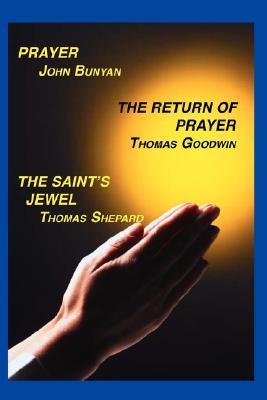
Prayer, Return of Prayer and the Saint's Jewel
by John Bunyan
Prayer is an ordinance of God, and that to be used both in public and private; yea, such an ordinance will bring those that have the spirit of supplication into great familiarity with God; and is also so prevalent an action, that it gets of God, both for the person that prays, and for them that are prayed for, great things. It is the opener of the heart of God, and a means by which the soul, though empty, is filled. By prayer the Christian can open his heart to God, as to a friend and obtain fresh testimony of God's friendship to him - I might spend many words in distinguishing between public and private prayer as also between that in the heart, and that with the vocal voice. Something also might be spoken to distinguish between the gifts and graces of prayer; but as eschewing this method my business shall be at this time only to show you the very heart of prayer, without which, all your lifting up both of hands, and eyes, and voices, will be to no purpose at all. Prayer is a sincere, sensible, affectionate pouring out of the heart or soul to God, through Christ, in the strength and assistance of the Holy Spirit, for such things as God has promised, or according to the Word for the good of the Church, with submission, in faith, to the will of God. 1. For the first of these: it is a sincere pouring out of the soul to God. Sincerity is such a grace as runs through all the graces of God in us, and through all the actings of a Christian, and has the sway in them too, or else their actings are not anything regarded of God, and so of and in prayer, of which particularly David speaks, when he mentions prayer: "7 cried unto the Lord with my mouth, and He was extolled with my tongue. If I regard iniquity in my heart, the Lord will not hear me " (Psa. 68:18). Part of the exercise of prayer is sincerity, without which God looks not upon it as prayer in a good sense. "And ye shall seek Me, and find Me, when ye shall search for Me with all your heart" (Jer. 29:13). The want of this made the Lord reject their prayers in Hos. 7:14, where He says, "They have not cried to Me with their hearts (that is, in sincerity), when they howled upon their beds "! But for a pretense, for a show, in hypocrisy, to be seen of men, and applauded for the same, they pray. Sincerity was that which Christ commended in Nathaniel when he was under the fig-tree: "Behold an Israelite indeed, in whom is no guile" (John 1:47). Probably this good man was pouring out of his soul to God in prayer under the fig-tree, and that in a sincere and unfeigned spirit before the Lord. The prayer that has this in it as one of the principal ingredients is the prayer that God looks at: "The prayer of the upright is His delight. " Bunyan (1628-1688) rose from an humble beginning to being a preacher to a little house church, to 12 years in jail because he would not agree to quit preaching, to a huge church in London. He wrote 66 books, nearly all while in jail. Goodwin (1600-1679) was rightly described as ''one of the twin pillars of the Puritan movement.'' His 12 volumes are filled with information not to be found in any other works. Thomas Shepard was an early New England Puritan. His work was praised at once by eminent divines, four of them being Westminster Confession participants. Jonathan Edwards quoted from Shepard more than any other.
BUY NOW
Paperback, 84 pages
Published January 25th 2007 by Sovereign Grace Publishers
Subscribe
Get Bible verse every day in your inbox
Read on Mobile



Group of Brands


















© 2025 Bibleportal.com All rights reserved.
John Bunyan (1628 - 1688)
Was the most famous of the Puritan writers and preachers. He was born at Harrowden (1 mile south-east of Bedford), in the Parish of Elstow, England. He is most well-known for his book “The Pilgrim's Progress”, one of the most printed books in history, which he composed while in prison for the crime of preaching the Gospel without a license.John Bunyan wrote The Pilgrim's Progress in two parts, of which the first appeared at London in 1678,which he had begun during his imprisonment in 1676. The second part appeared in 1684. The earliest edition in which the two parts were combined in one volume came out in 1728. A third part falsely attributed to Bunyan appeared in 1693. The Pilgrim's Progressis the most successful allegory ever written, and like the Bible has been extensively translated into other languages.
John Bunyan was an English Christian writer and preacher, famous for writing The Pilgrim's Progress, arguably the most published book besides the Bible. In the Church of England, he is remembered with a Lesser Festival on 30 August.
He had very little schooling (about 2-4 years). He was educated at his father's house with other poor country boys and what little education he received was to benefit his father and his own future trade.
Bunyan became a popular preacher as well as a prolific author, though most of his works consist of expanded sermons. Though a Baptist preacher, in theology he was a Puritan.
His affinity for the oral tradition and his voracious reading lead to his work being primarily influenced by sermons, homilies in dialog form, folk tales, books of emblems and allegories. "Most of the didactic works of Bunyan's era have vanished into oblivion. His allegory's power derives from the imaginative force with which he brings didactic themes to life and the wonderfully living prose in which he dramatizes the conflicts of the spirit".
Bunyan wrote about 60 books and tracts, of which The Holy War ranks next to The Pilgrim's Progress in popularity. A passage from Part Two of The Pilgrim's Progress beginning "Who would true Valour see" has been used in the hymn "To be a Pilgrim".
The name of John Bunyan is forever linked with the town of Bedford. Bunyan was born in 1628 just outside the village of Elstow, on the outskirts of modern Bedford. His precise birth site is unknown, though it seems likely he was born in a now lost cottage near two fields called "Further Bunyans" and "Bunyans". A plaque on the supposed site of the cottage was erected in 1951.
He was the son of a tinker, and may well have helped his father in that occupation during his youth. Bunyan reported on his own childhood that he loved to play "tip-cat", a form of rounders, on the village green in Elstow.
Bunyan fought in the Civil War on the side of Parliament and when the conflict ended he returned to Elstow and married a local woman who's name was probably Mary. He had four children with his first wife, including a girl who was blind from birth.
It may partly have been this occurrence that led him to question his rowdy lifestyle and search for a deeper sense of meaning in his life. Bunyan began attending a new religious congregation meeting at St. John's Church, Bedford. He became good friends with the pastor, John Gifford.
When Gifford died, Bunyan took his place as head of the congregation, and he travelled the district preaching, generally out of doors. When the Restoration of the monarchy took place in 1660 preaching was forbidden in an attempt to restrain the growth of Independent Congregations. Bunyan refused to stop preaching, and he was arrested in the village of Samsell. He was tried at Bedford Assizes and ordered held in the County Gaol until he agreed to conform.
For the next 12 years Bunyan remained in gaol, in generally poor conditions, though he was allowed visitors and occasionally he was allowed out on what we would today consider "day leave". His second wife Elizabeth appeared before the Lord Chief Justice of England, Matthew Hale, to plead for her husband's release, but her appeal was refused.
Bunyan spent his time in gaol writing a number of books on religious themes, including his biography. Most importantly, he produced the religious allegorical novel, The Pilgrim's Progress, which was eventually published in 1678.
In 1672 Charles II issued his Declaration of Religious Indulgences, and Bunyan, along with other religious offenders, was released from custody. He bought a barn on Mill Street and converted the building to a home for his Independent Congregation.
But in 1673 the king was pressured into repealing his Declaration, and Bunyan was cast back into gaol until 1677.
Bunyan wrote a further 40 books before his death 1n 1688. He is buried in Bunhill Fields, City Road, London.
... Show more