
- Bible
- Read the Bible
- Bible Versions
- Verse of the Day
- Reading Plans
- Verses by Topic
- Books of the Bible
- Bible Images
- Study
- Commentaries
- Concordances
- Dictionaries
- Encyclopedias
- Sermons
- Bible Atlas & Maps
- BP Wiki
- Devotionals
- Today's Devotionals
- Light of the World
- All Devotionals
- Inspirational Quotes
- More
- Picture Quotes
- Videos
- Inspirational
- Bible Study
- What The Bible Says
- Bible Q&As
- Daily Bread
- Bible by Genre
- Bible Stories
- Random Bible Verse
- Community
- Store
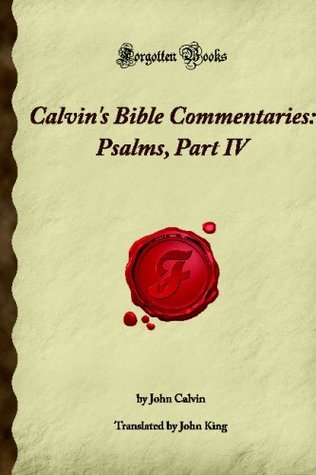
Bible Commentaries: Psalms, Part IV
by John Calvin
Book Description:Book Description:
"The father of modern reformed theology, Calvin was born in 1509, and after Martin Luther was a premiere leader in the Protestant movement. Quoting Charles Spurgeon: "It would not be possible for me too earnestly to press upon you the importance of reading the expositions of that prince among men, John Calvin..." Quoting Arminius: "I affirm that he excels beyond comparison in the interpretation of Scripture, and that his commentaries ought to be more highly valued than all that is handed down to us by the Library of the Fathers; so that I acknowledge him to have possessed above most others, or rather above all other men, what may be called an eminent gift of prophecy"." (Quote from Spurgeon's "Commenting and Commentaries", 1876)(Quote from Spurgeon's "Commenting and Commentaries", 1876)
Table of Contents:Table of Contents:
Publisher's Preface; Psalm 93; Psalm 94; Psalm 95; Psalm 96; Psalm 97; Psalm 98; Psalm 99; Psalm 100; Psalm 101; Psalm 102; Psalm 103; Psalm 104; Psalm 105; Psalm 106; Psalm 107; Psalm 108; Psalm 109; Psalm 110; Psalm 111 ; Psalm 112; Psalm 113; Psalm 114; Psalm 115; Psalm 116; Psalm 117; Psalm 118; Psalm 119; Endnotes
About the Publisher:About the Publisher:
Forgotten Books is a publisher of historical writings, such as: Philosophy, Classics, Science, Religion, Esoteric and Mythology. www.forgottenbooks.orgwww.forgottenbooks.org
Forgotten Books is about sharing information, not about making money. All books are priced at wholesale prices. We are also the only publisher we know of to print in large sans-serif font, which is proven to make the text easier to read and put less strain on your eyes.
"The father of modern reformed theology, Calvin was born in 1509, and after Martin Luther was a premiere leader in the Protestant movement. Quoting Charles Spurgeon: "It would not be possible for me too earnestly to press upon you the importance of reading the expositions of that prince among men, John Calvin..." Quoting Arminius: "I affirm that he excels beyond comparison in the interpretation of Scripture, and that his commentaries ought to be more highly valued than all that is handed down to us by the Library of the Fathers; so that I acknowledge him to have possessed above most others, or rather above all other men, what may be called an eminent gift of prophecy"." (Quote from Spurgeon's "Commenting and Commentaries", 1876)(Quote from Spurgeon's "Commenting and Commentaries", 1876)
Table of Contents:Table of Contents:
Publisher's Preface; Psalm 93; Psalm 94; Psalm 95; Psalm 96; Psalm 97; Psalm 98; Psalm 99; Psalm 100; Psalm 101; Psalm 102; Psalm 103; Psalm 104; Psalm 105; Psalm 106; Psalm 107; Psalm 108; Psalm 109; Psalm 110; Psalm 111 ; Psalm 112; Psalm 113; Psalm 114; Psalm 115; Psalm 116; Psalm 117; Psalm 118; Psalm 119; Endnotes
About the Publisher:About the Publisher:
Forgotten Books is a publisher of historical writings, such as: Philosophy, Classics, Science, Religion, Esoteric and Mythology. www.forgottenbooks.orgwww.forgottenbooks.org
Forgotten Books is about sharing information, not about making money. All books are priced at wholesale prices. We are also the only publisher we know of to print in large sans-serif font, which is proven to make the text easier to read and put less strain on your eyes.
BUY NOW
Paperback, 460 pages
Published December 11th 2007 by Forgotten Books
Subscribe
Get Bible verse every day in your inbox
Read on Mobile



Group of Brands


















© 2026 Bibleportal.com All rights reserved.
John Calvin (1509 - 1584)
Was an influential French theologian and pastor during the Protestant Reformation. He was a principal figure in the development of the system of Christian theology later called Calvinism. Originally trained as a humanist lawyer, he broke from the Roman Catholic Church around 1530. After religious tensions provoked a violent uprising against Protestants in France, Calvin fled to Basel, Switzerland, where he published the first edition of his seminal work The Institutes of the Christian Religion in 1536.Calvin's writing and preachings provided the seeds for the branch of theology that bears his name. The Reformed, Congregational, and Presbyterian churches, which look to Calvin as the chief expositor of their beliefs, have spread throughout the world.
John Calvin was an influential French theologian and pastor during the Protestant Reformation. He was a principal figure in the development of the system of Christian theology later called Calvinism. Originally trained as a humanist lawyer, he broke from the Roman Catholic Church around 1530. After religious tensions provoked a violent uprising against Protestants in France, Calvin fled to Basel, Switzerland, where in 1536 he published the first edition of his seminal work Institutes of the Christian Religion.
Calvin's writing and preaching provided the seeds for the branch of theology that bears his name. The Presbyterian and other Reformed churches, which look to Calvin as a chief expositor of their beliefs, have spread throughout the world. Calvin's thought exerted considerable influence over major religious figures and entire religious movements, such as Puritanism, and some have argued that his ideas have contributed to the rise of capitalism, individualism, and representative democracy in the West.
Founder of Calvinism. John Calvin, a French scholar who became a leading preacher and dominant force in the Reformation of the 16th Century, studied at the University of Paris and at the University of Orleans. He became dissatisfied with the teachings of the Roman Catholic Church and allied himself with the cause of the Protestant Reformation in 1532.
When the king of France decided to settle the religious question in his country in favor of the Catholics, Calvin fled to Geneva, Switzerland, where his writings and lectures made Geneva the Rome of Protestantism. His institutes of the Christian religion became the basis for the Presbyterian way of thought and church life. Calvinism is the main doctrine of the Presbyterian and Reformed Churches.
... Show more