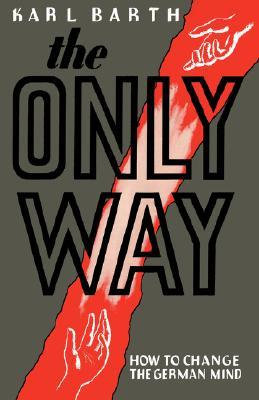
"Man has always been ill and always will be." from "How Can the Germans Be Cured?" The Only Way: How to Change the German Mind details author Karl Barth's theories on German politics and history and confronts "the problem with Germany." In successive articles and letters, Barth analyzes the rise of Nazism and Hitler's power to understand German guilt and connect history to present-day Germany. This edition was translated from the German by Marta K. Neufeld and Ronald Gregor Smith. Karl Barth was an influential Swiss philosopher, theologian, and author. He wrote The Epistle to the Romans, Church Dogmatics, The Humanity of God and countless essays, articles, and lectures.






















Karl Barth was a Swiss Reformed theologian whom critics hold to be among the most important Christian thinkers of the 20th century.
Beginning with his experience as a pastor, he rejected his training in the predominant liberal theology typical of 19th-century Protestantism. Instead he embarked on a new theological path initially called dialectical theology, due to its stress on the paradoxical nature of divine truth (e.g., God's relationship to humanity embodies both grace and judgment). Other critics have referred to Barth as the father of neo-orthodoxy -- a term emphatically rejected by Barth himself. The most accurate description of his work might be "a theology of the Word." Barth's theological thought emphasized the sovereignty of God, particularly through his innovative doctrine of election.
Barth tries to recover the Doctrine of the Trinity in theology from its putative loss in liberalism. His argument follows from the idea that God is the object of God's own self-knowledge, and revelation in the Bible means the self-unveiling to humanity of the God who cannot be discovered by humanity simply through its own efforts.
... Show more