
- Bible
- Read the Bible
- Bible Versions
- Verse of the Day
- Reading Plans
- Verses by Topic
- Books of the Bible
- Bible Images
- Study
- Commentaries
- Concordances
- Dictionaries
- Encyclopedias
- Sermons
- Bible Atlas & Maps
- BP Wiki
- Devotionals
- Today's Devotionals
- All Devotionals
- Inspirational Quotes
- More
- Picture Quotes
- Videos
- Inspirational
- Bible Study
- What The Bible Says
- Bible Q&As
- Daily Bread
- Bible by Genre
- Bible Stories
- Random Bible Verse
- Community
- Store
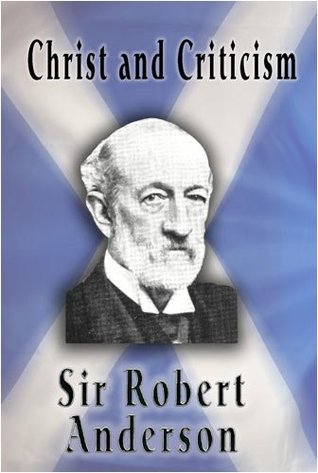
Christ and Criticism
by Robert Anderson
"The dethronement of the Bible leads practically to the dethronement of God; and in Germany and America, and now in England, the effects of this are declaring themselves in ways, and to an extent, well fitted to cause anxiety for the future." Christ And Criticism
"Fitness for dealing with evidence depends upon qualities to which Hebraists, as such, have no special claim. Indeed, their writings afford signal proofs of their unfitness for inquiries which they insist on regarding as their special preserve." Christ And Criticism
"As critics they brand the Pentateuch as a tissue of myth and legend and fraud, but as religionists they assure us that this implies no denial of its inspiration or disparagement of its contents... To characterize the writings of these scholars as they deserve is not a grateful task, but the time has come to throw off reserve when such drivel as this is gravely put forward to induce us to tear from our Bible the Holy Scriptures on which our Divine Lord based His claims to Messiahship." Christ And Criticism
"The fact that sacrifice prevailed among all races can be explained only by a primeval revelation. And the Bible student will recognize that God thus sought to impress on men that death was the penalty of sin, and to lead them to look forward to a great blood shedding that would bring life and blessing to mankind. But Babylon was to the ancient world what Rome has been to Christendom. It corrupted every divine ordinance and truth, and perpetuated them as thus corrupted. And in the Pentateuch we have the divine re-issue of the true cult. The figment that the debased and corrupt version was the original may satisfy some professors of Hebrew, but no one who has any practical knowledge of human nature would entertain it." Christ And Criticism
"The only foundation for the "assured results of modern criticism," as they themselves acknowledge, consists of "grounds of probability" and "plausible arguments"! In no civilized country would an habitual criminal be convicted of petty larceny on such evidence as this; and yet it is on these grounds that we are called upon to give up the sacred books which our Divine Lord accredited as the Word of God and made the basis of His doctrinal teaching." Christ And Criticism
"To deny that the Spirit of God could thus communicate truth to men, or, in other words, to reject verbal inspiration on a priori grounds, betrays the stupidity of systematized unbelief... It is amazing that any one who regards the coming of Christ as God's supreme revelation of Himself can imagine that (to put it on no higher ground than Providence) the Divine Spirit could fail to ensure that mankind should have a trustworthy and true record of His mission and His teaching." Christ And Criticism
"Fitness for dealing with evidence depends upon qualities to which Hebraists, as such, have no special claim. Indeed, their writings afford signal proofs of their unfitness for inquiries which they insist on regarding as their special preserve." Christ And Criticism
"As critics they brand the Pentateuch as a tissue of myth and legend and fraud, but as religionists they assure us that this implies no denial of its inspiration or disparagement of its contents... To characterize the writings of these scholars as they deserve is not a grateful task, but the time has come to throw off reserve when such drivel as this is gravely put forward to induce us to tear from our Bible the Holy Scriptures on which our Divine Lord based His claims to Messiahship." Christ And Criticism
"The fact that sacrifice prevailed among all races can be explained only by a primeval revelation. And the Bible student will recognize that God thus sought to impress on men that death was the penalty of sin, and to lead them to look forward to a great blood shedding that would bring life and blessing to mankind. But Babylon was to the ancient world what Rome has been to Christendom. It corrupted every divine ordinance and truth, and perpetuated them as thus corrupted. And in the Pentateuch we have the divine re-issue of the true cult. The figment that the debased and corrupt version was the original may satisfy some professors of Hebrew, but no one who has any practical knowledge of human nature would entertain it." Christ And Criticism
"The only foundation for the "assured results of modern criticism," as they themselves acknowledge, consists of "grounds of probability" and "plausible arguments"! In no civilized country would an habitual criminal be convicted of petty larceny on such evidence as this; and yet it is on these grounds that we are called upon to give up the sacred books which our Divine Lord accredited as the Word of God and made the basis of His doctrinal teaching." Christ And Criticism
"To deny that the Spirit of God could thus communicate truth to men, or, in other words, to reject verbal inspiration on a priori grounds, betrays the stupidity of systematized unbelief... It is amazing that any one who regards the coming of Christ as God's supreme revelation of Himself can imagine that (to put it on no higher ground than Providence) the Divine Spirit could fail to ensure that mankind should have a trustworthy and true record of His mission and His teaching." Christ And Criticism
BUY NOW
Kindle Edition
Published June 9th 2008 by GraceWorks Multimedia
Subscribe
Verse of the Day
Get a Bible verse delivered to your inbox every day!
Daily Devotional
Subscribe to receive daily devotionals to help you grow in faith and walk closer with God.
Read on Mobile



Group of Brands


















© 2026 Bibleportal.com All rights reserved.
Sir Robert Anderson was born in Dublin, Ireland and was of Scottish descent. His father was an elder in the Irish Presbyterian Church and he was raised in a religious home. Anderson's conversion took place after listening to a sermon delivered by John Hall.
Sir Robert Anderson graduated from Trinity College, Dublin, in 1862 and was called to the Irish Bar in 1863. He later became Assistant Commissioner of the Metropolitan Police and Chief of the Criminal Investigation Department at Scotland Yard. When he retired in 1901, he was made Knight Commander of the the Order of the Bath. W. H. Smith, on the floor of the House of Commons, said Sir Robert "had discharged his duties with great ability and perfect faithfulness to the public."
Sir Robert Anderson was the chief inspector for Scotland Yard. He was greatly respected for his skill as an investigator. When Anderson wasn't writing on subjects related to crime, he wrote books on Christian prophecy. He helped establish the fact that 69 of Daniel's 70 weeks have now transpired, and that the tribulation will be the 70th week. Sir Robert Anderson's book, The Coming Prince, has become a foundational resource for all dispensationalists.
... Show more