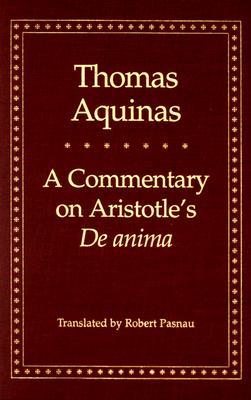
This new translation of Thomas Aquinas’s most important study of Aristotle casts bright light on the thinking of both philosophers. Using a new text of Aquinas’s original Latin commentary (René-Antoine Gauthier’s Leonine edition of 1984), Robert Pasnau provides a precise translation that will enable students to undertake close philosophical readings. He includes an introduction and notes to set context and clarify difficult points as well as a translation of the medieval Latin version of Aristotle’s De anima De anima (On the Soul) so that readers can refer to the text Aquinas had at hand.
In his De anima commentaryDe anima commentary, Aquinas offers the first and most original of his studies of Aristotle. His influential, cogent reading of Aristotle’s notoriously difficult text not only contributes to our understanding of the Greek philosopher but also expresses in full detail Aquinas’s own views on central philosophical topics. Writing at the height of his intellectual powers, Aquinas considers in full detail the nature of the soul, the mind-body problem, the role of the intellect, the character of sensation, and many other related issues.






















Thomas Aquinas was an immensely influential philosopher and theologian in the tradition of scholasticism, known as Doctor Angelicus and Doctor Communis.
He was the foremost classical proponent of natural theology, and the father of the Thomistic school of philosophy and theology. His influence on Western thought is considerable, and much of modern philosophy was conceived as a reaction against, or as an agreement with, his ideas, particularly in the areas of ethics, natural law and political theory.
The philosophy of Aquinas has exerted enormous influence on subsequent Christian theology, especially that of the Roman Catholic Church, extending to Western philosophy in general, where he stands as a vehicle and modifier of Aristotelianism, which he fused with the thought of Augustine.
... Show more