
- Bible
- Read the Bible
- Bible Versions
- Verse of the Day
- Reading Plans
- Verses by Topic
- Books of the Bible
- Bible Images
- Study
- Commentaries
- Concordances
- Dictionaries
- Encyclopedias
- Sermons
- Bible Atlas & Maps
- BP Wiki
- Devotionals
- Today's Devotionals
- Light of the World
- All Devotionals
- Inspirational Quotes
- More
- Picture Quotes
- Videos
- Inspirational
- Bible Study
- What The Bible Says
- Bible Q&As
- Daily Bread
- Bible by Genre
- Bible Stories
- Random Bible Verse
- Community
- Store
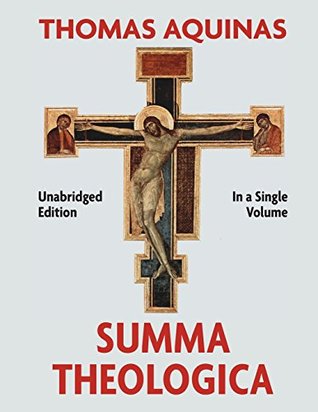
Summa Theologica Complete in a Single Volume
by Thomas Aquinas
The Summa Theologica is a compendium of theology written by Thomas Aquinas between 1265 and 1273. In Roman Catholicism, it is the sum of all known learning and doctrine, of all that can be known about God and humanity's relations with God - a landmark in the history of theology that famously offers five proofs of God's existence, the first of three of which are cosmological arguments; the fourth, a moral argument; and the fifth, a teleological argument.
The third quarter of the thirteenth century marked the first decisive philosophical encounter between Hellenism and Christianity. The rediscovery of Aristotle's works after the Dark Ages ushered in a new era of intellectual fervor in Europe, and the work of Thomas Aquinas is a commentary on Aristotle, whose writings were lost to the non-Arabic world until the beginning of the thirteenth century. To many, Aristotle's worldview was a pagan threat to Christianity. To Aquinas, it provided an exciting cosmological framework on which to build an all-encompassing Christian worldview. His thoughts unfolding with a calmness of order and an assurance of judgment, Aquinas explores in the Summa the primary role of the senses in the acquisition of knowledge and the metaphysical analysis of things in terms of matter and form. But unlike Aristotle's "God," who did not care one whit about the world, the God of Christianity, insisted Aquinas, is a personal God. Like Aristotle, Aquinas believed that each human being has a soul and that all created things have a purpose. For Christians, all are part of a divine plan.
This dazzling synthesis of Catholic doctrine has had a profound impact on Christian thinking since the thirteenth century and has become the de facto official teaching of the Catholic Church - the intellectual underpinning of the Church to this day.
The third quarter of the thirteenth century marked the first decisive philosophical encounter between Hellenism and Christianity. The rediscovery of Aristotle's works after the Dark Ages ushered in a new era of intellectual fervor in Europe, and the work of Thomas Aquinas is a commentary on Aristotle, whose writings were lost to the non-Arabic world until the beginning of the thirteenth century. To many, Aristotle's worldview was a pagan threat to Christianity. To Aquinas, it provided an exciting cosmological framework on which to build an all-encompassing Christian worldview. His thoughts unfolding with a calmness of order and an assurance of judgment, Aquinas explores in the Summa the primary role of the senses in the acquisition of knowledge and the metaphysical analysis of things in terms of matter and form. But unlike Aristotle's "God," who did not care one whit about the world, the God of Christianity, insisted Aquinas, is a personal God. Like Aristotle, Aquinas believed that each human being has a soul and that all created things have a purpose. For Christians, all are part of a divine plan.
This dazzling synthesis of Catholic doctrine has had a profound impact on Christian thinking since the thirteenth century and has become the de facto official teaching of the Catholic Church - the intellectual underpinning of the Church to this day.
BUY NOW
Paperback, 1116 pages
Published May 14th 2018 by Coyote Canyon Press
Subscribe
Get Bible verse every day in your inbox
Read on Mobile



Group of Brands


















© 2026 Bibleportal.com All rights reserved.
Thomas Aquinas was an immensely influential philosopher and theologian in the tradition of scholasticism, known as Doctor Angelicus and Doctor Communis.
He was the foremost classical proponent of natural theology, and the father of the Thomistic school of philosophy and theology. His influence on Western thought is considerable, and much of modern philosophy was conceived as a reaction against, or as an agreement with, his ideas, particularly in the areas of ethics, natural law and political theory.
The philosophy of Aquinas has exerted enormous influence on subsequent Christian theology, especially that of the Roman Catholic Church, extending to Western philosophy in general, where he stands as a vehicle and modifier of Aristotelianism, which he fused with the thought of Augustine.
... Show more