
- Bible
- Read the Bible
- Bible Versions
- Verse of the Day
- Reading Plans
- Verses by Topic
- Books of the Bible
- Bible Images
- Study
- Commentaries
- Concordances
- Dictionaries
- Encyclopedias
- Sermons
- Bible Atlas & Maps
- BP Wiki
- Devotionals
- Today's Devotionals
- Light of the World
- All Devotionals
- Inspirational Quotes
- More
- Picture Quotes
- Videos
- Inspirational
- Bible Study
- What The Bible Says
- Bible Q&As
- Daily Bread
- Bible by Genre
- Bible Stories
- Random Bible Verse
- Community
- Store
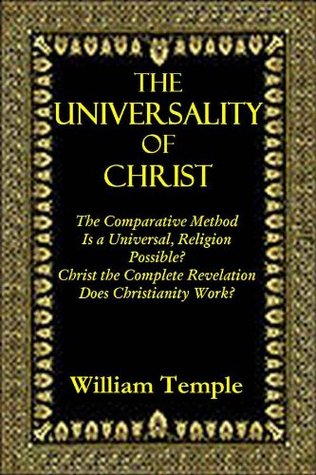
The Universality of Christ
by William Temple
PREFACE The four lectures published in this volume were delivered at the Conference of the Student Christian Movement held at Glasgow in January 1921. They were framed with a view to suggesting answers to problems specially prominent in the minds of students at that moment. Their unity, so far as they have any, is to be found in a phase of contemporary thought, though I hope that the philosophic skeleton, on which my suggested answers to various problems depend, is itself a coherent whole. I have endeavoured to state my own position without reference to previous controversies, for the lectures were not addressed to theological specialists. But on one point I would take this opportunity of expressing my relation to classical disputes of the past. The Christological controversies of the Early Church were conducted in terms of a psychology very different from ours, and it was not found possible to do justice (as I think) to certain aspects of the matter without becoming involved in philosophical and theological conclusions which are contrary to fundamental elements in Christian experience. Paul of Samosata was not merely wrong in wishing to interpret the divinity of Christ in terms of will, but his psychology of volition was so defective that his attempt resulted in a disastrous theology. Nestorius may or may not have been a "Nestorian"; it is significant that he regarded the formula of Chalcedon as a triumph for his cause. In any case the condemnation of the Monothelite heresy went far towards the affirmation of a human individuality in the Incarnate Person of Jesus Christ. It would be absurd to suggest that in these lectures I have even adumbrated a Christology; I hope I may have the opportunity of undertaking such a task before very long. But I wish to state that I have quite deliberately revived in substance a part, at least, of the contention of Nestorius, in the belief that a more adequate psychology can, without any disastrous theological consequences, do justice to those aspects of truth by which he was especially impressed. If anyone cares to follow out the line of thought indicated in these lectures, he will find parts of the argument contained in this volume more fully developed in The Faith and Modem Thought, The Nature of Personality, Church and Nation, and especially Mens Creatrix—all of which are published by Messrs Macmillan.
BUY NOW
Kindle Edition, 108 pages
Published September 29th 2010 by Evergreen Review, Inc.
Subscribe
Get Bible verse every day in your inbox
Read on Mobile



Group of Brands


















© 2026 Bibleportal.com All rights reserved.
William Temple was a priest in the Church of England. He served as Bishop of Manchester (1921–29), Archbishop of York (1929–42), and Archbishop of Canterbury (1942–44).
A renowned teacher and preacher, Temple is perhaps best known for his 1942 book Christianity and Social Order, which set out an Anglican social theology and a vision for what would constitute a just post-war society. Also in 1942, with Chief Rabbi Joseph Hertz, Temple jointly founded the Council of Christians and Jews to combat anti-Jewish bigotry.
... Show more