
Inspirational Quotes on Philosophy


“I still accept an imperative of knowledge, through which men may be influenced, but then it must come alive in me, and this is what I now recognize as the most important of all. This is what my soul thirsts for as the African deserts thirst for water. This is what I need to live, a completely human life and not merely one of knowledge”
“Is it not possible that my activity as an objective observer of nature will weaken my strength as a human being?”
“A fé não constitui, portanto, um impulso de ordem estética; é de outra ordem muito mais elevada, justamente porque pressupõe a resignação. Não é o instinto imediato do coração, mas o paradoxo da vida.”
“Although I am still far from this kind of interior understanding of myself, with profound respect for its significance I have sought to preserve my individuality―worshipped the unknown God. With a premature anxiety I have tried to avoid coming in close contact with those things whose force of attraction might be too powerful for me. I have sought to appropriate much from them, studied their distinctive characteristics and meaning in human life, but at the same time guarded against coming, like the moth, too close to the flame. I have had little to win or to lose in association with the ordinary run of men, partly because what they do―so-called practical life―does not interest me much, partly because their coldness and indifference to the spiritual and deeper currents in man alienate me even more from them. With few exceptions my companions have had no special influence upon me. A life that has not arrived at clarity about itself must necessarily exhibit an uneven side-surface; confronted by certain facts [*Facta*] and their apparent disharmony, they simply halted there, for, as I see it, they did not have sufficient interest to seek a resolution in a higher harmony or to recognize the necessity of it. Their opinion of me was always one-sided, and I have vacillated between putting too much or too little weight on what they said. I have now withdrawn from their influence and the potential variations of my life's compass resulting from it. Thus I am again standing at the point where I must begin again in another way. I shall now calmly attempt to look at myself and begin to initiate inner action; for only thus will I be able, like a child calling itself "I" in its first consciously undertaken act, be able to call myself "I" in a profounder sense. But that takes stamina, and it is not possible to harvest immediately what one has sown. I will remember that philosopher's method of having his disciples keep silent for three years; then I dare say it will come. Just as one does not begin a feast at sunrise but at sundown, just so in the spiritual world one must first work forward for some time before the sun really shines for us and rises in all its glory; for although it is true as it says that God lets his sun shine upon the good and the evil and lets the rain fall on the just and the unjust, it is not so in the spiritual world. So let the die be cast―I am crossing the Rubicon! No doubt this road takes me into battle, but I will not renounce it. I will not lament the past―why lament? I will work energetically and not waste time in regrets, like the person stuck in a bog and first calculating how far he has sunk without recognizing that during the time he spends on that he is sinking still deeper. I will hurry along the path I have found and shout to everyone I meet: Do not look back as Lot's wife did, but remember that we are struggling up a hill." ―from_Journals_, (The Search for Personal Meaning)”
“How far removed in time must an event be for us to remember it? How far for memory's longing to be no longer able to seize it? Most people have a limit in this respect: what lies too near them in time they cannot remember, nor what lies too remote. I know no limit. What was experienced yesterday, I push back a thousand years in time, and remember as if it were yesterday." ―Johannes de Silentio, from_Either/Or_”
“A person who speaks like a book is exceedingly boring to listen to; sometimes, however, it is not inappropriate to talk in that way. For a book has the remarkable property that it can be interpreted any way you wish. If one talks like a book one’s conversation acquires this property too. I kept quite soberly to the usual formulas. She was surprised, as I’d expected; that can’t be denied. To describe to myself how she looked is difficult. She seemed multifaceted; yes just about like the still to be published but announced commentary to my book, a commentary capable of any interpretation. One word and she would have laughed at me; another and she would have been moved; still another and she would have shunned me; but no such word came to my lips. I remained solemnly unemotional and kept to the ritual.― ‘She had known me for such a short time’, dear God, it’s only on the strait path of engagement one meets such difficulties, not the primrose path of love.” ―from_Either/Or: A Fragment of Life_. Abridged, Translated and with an Introduction and Notes by Alastair Hannay, p. 312”
“I have a secret to confide to you, my confidante. Who should I confide it to? To Echo? She would betray it. To the stars? They are cold. People? They do not understand. Only to you can I confide it, for you know how to safeguard it. There is a girl, more beautiful than my soul’s dream, purer than the light of the sun, deeper than the source of the ocean, more proud than the flight of the eagle―there is a girl―oh! bend your head to my ear and my words, that my secret may steal into it―this girl I love more dearly than my life, for she is my life; more dearly than all my desires, for she is the only one; more dearly than all my thoughts, for she is the only one; more warmly than the sun loves the flower, more intensely than sorrow the privacy of the troubled mind; more longingly than the desert’s burning sand loves the rain―I cling to her more tenderly than the mother’s eye to the child, more confidingly than the pleading soul to God, more inseparably than the plant to its root.―Your head grows heavy and thoughtful, it sinks down on your breast, your bosom rises to its aid―my Cordelia! You have understood me, you have understood me exactly, to the letter, not one jot have you ignored. Shall I stretch the membrane of my ear and let your voice assure me of this? Should I doubt? Will you safeguard this secret? Can I depend on you? One hears of people who, in terrible crimes, dedicate themselves to mutual silence. I have confided to you a secret which is my life and my life’s content. Have you nothing to confide to me, nothing so beautiful, so significant…?” ―Johannes de Silentio, from_Either/Or_”
“The surest of stubborn silences is not to hold one's tongue but to talk”
“For clarity's sake, and before going further with this account, I shall identify true aesthetic sorrow a little more closely. Sorrow has the opposite movement to that of pain. So long as one doesn't spoil things out of a misplaced mania for consistency―something I shall prevent also in another way―one may say: the more innocence, the deeper the sorrow. If you press this too far, you destroy the tragic. There is always an element of guilt left over, but it is never properly reflected in the subject; which is why in Greek tragedy the sorrow is so deep. In order to prevent misplaced consistency, I shall merely remark that exaggeration only succeeds in carrying the matter over into another sphere. The synthesis of absolute innocence and absolute guilt is not an aesthetic feature but a metaphysical one. This is the real reason why people have always been ashamed to call the life of Christ a tragedy; one feels instinctively that aesthetic categories do not exhaust the matter. It is clear in another way, too that Christ's life amounts to more than can be exhausted in aesthetic terms, namely from the fact that these terms neutralize themselves in this phenomenon, and are rendered irrelevant. Tragic action always contains an element of suffering, and tragic suffering an element of action; the aesthetic lies in the relativity. The identity of an absolute action and an absolute suffering is beyond the powers of aesthetics and belongs to metaphysics. This identity is exemplified in the life of Christ, for His suffering is absolute because the action is absolutely free, and His action is absolute suffering because it is absolute obedience. The element of guilt that is always left over is, accordingly, not subjectively reflected and this makes the sorrow deep. Tragic guilt is more than just subjective guilt, it is inherited guilt. But inherited guilt, like original sin, is a substantial category, and it is just this substantiality that makes the sorrow deeper. Sophocles' celebrated tragic trilogy, *Oedipus at Colonus*, *Oedipus Rex*, and *Antigone*, turns essentially on this authentic tragic interest. But inherited guilt contains the self-contradiction of being guilt yet not being guilt. The bond that makes the individual guilty is precisely piety, but the guilt which he thereby incurs has all possible aesthetic ambiguity. One might well conclude that the people who developed profound tragedy were the Jews. Thus, when they say of Jehova that he is a jealous God who visits the sins of the fathers on the children unto the third and fourth generations, or one hears those terrible imprecations in the Old Testament, one might feel tempted to look here for the material of tragedy. But Judaism is too ethically developed for this. Jehova's curses, terrible as they are, are nevertheless also righteous punishment. Such was not the case in Greece, there the wrath of the gods has no ethical, but aesthetic ambiguity" (Either/Or).”
“Mine’: what does this word mean? Not what belongs to me, but what I belong to, what contains my whole being, which is mine only so far as I belong to it. My God is not the God that belongs to me, but the God to whom I belong; and so, too, when I say my native land, my home, my calling, my longing, my hope. If there had been no immortality before, this thought that I am yours would be a breach of the normal course of nature.” —Johannes the Seducer, from_Either/Or_”
“What am I? The modest narrator who accompanies your triumphs; the dancer who supports you when you rise in your lovely grace; the branch upon which you rest a moment when you are tired of flying; the bass that interposes itself below the soprano’s fervour to let it climb even higher—what am I? I am the earthly gravity that keeps you on the ground. What am I, then? Body, mass, earth, dust and ashes.—You, my […], you are soul and spirit.” —Johannes the Seducer, from_Either/Or_”

“In the morning consider that you may not live till evening, and when evening comes do not dare to promise yourself the dawn.”

“I first heard of Parmenides' best-known assertion, "Whatever is, is." I laughed and blurted out, "And he's famous?" With this verbal ejaculation I revealed myself as the quintessential sophomore.”

“If you have understood, then what you have understood is not God.”
“You have truly gained the mastery of the very stronghold of philosophy, Mother. For without doubt only for lack of words you did not elaborate on this subject as did Tullius [Cicero], whose words will follow. For in the Hortensius, the book he wrote on the praise and defense of philosophy, he said: ‘But see, surely not the philosophers but all given to argument say that those who live just as they wish are happy.’ This is definitely false; for to want what is not appropriate is the worst of all miseries. It is not so miserable not to get what you want as to want to get what you ought not. Wickedness of will brings to everyone greater evil than good fortune brings good.”
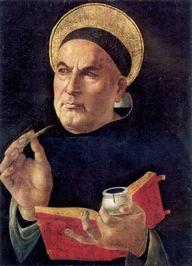
“If the citizens themselves devote their life to matters of trade, the way will be opened to many vices. Since the foremost tendency of tradesmen is to make money, greed is awakened in the hearts of the citizens through the pursuit of trade. The result is that everything in the city will bcome venal; good faith will be destroyed and the way opened to all kinds of trickery; each one will work only for his own profit, despising the public good; the cultivation of virtue will fail since honor, virtue's reward, will be bestowed upon the rich. Thus, in such a city, civic life will necessarily be corrupted. (On Kingship II, 3)”
topics: capitalism , civics , economics , ethics , money , philosophy , politics , theology , thomism , wealth
“How deluded we sometimes are by the clear notions we get out of books.”

“Something is objective if it is independent of people’s opinions. If it holds or is true independently of what anybody thinks then it is objective. It is subjective if it is dependent upon people’s opinions.”
“The most popular form of atheism is a philosophy called naturalism. Naturalism is the view that science and science alone determines what exists. What exists is what our best scientific theories of the world require. If something is not required by our best scientific theories of the world, then it does not exist. But this is devastating for ethics because moral values are not required by science. Science is morally neutral. You cannot find moral values in a test tube. So it follows immediately, from the perspective of naturalism, that moral values do not really exist. They are just subjective illusions of human beings.”



Group of Brands


















© 2026 Bibleportal.com All rights reserved.