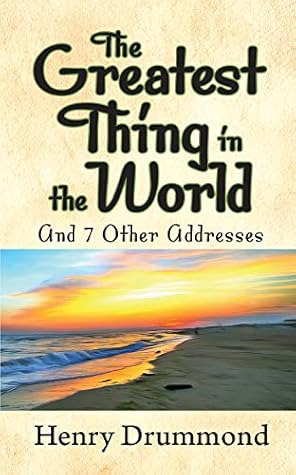
Seven additional addresses by Henry Drummond are included in this unparalleled volume along with The Greatest Think in the World, Henry Drummond’s most noted well-loved classic. A Christian missionary during the nineteenth century, he based his most famous work on 1 Corinthians 13. Embraced by readers who have successfully taken Drummond’s ideas and used them in their own lives, The Greatest Thing in The World provides life-changing insight into the nine components of love, including:
• Patience
• Kindness
• Generosity
• Humility
• Courtesy
• Unselfishness
• Good Temper
• Guilelessness
• Sincerity
Readers are encouraged to practice the power and blessing of love in every area of life. The message, Drummond’s concept of the most important ingredient in achieving and living a successful life, is beautiful, simple and honest.
Scholars have found The Greatest Thing in the World and his 7 additional addresses to be culturally important, and part of the knowledge base of civilization. The other works include:
Lessons from the Angelus
Pax Vobiscum
“First!" An Address to Boys
The Changed Life: The Greatest Need in the World
Dealing with Doubt
The Program of Christianity
The City Without a Church
“You will find as you look back upon your life that the moments when you have truly lived are the moments when you have done things in the spirit of love.”
—Henry Drummond






















Henry Drummond (1851 - 1897)
Was a Scottish evangelist, writer and lecturer. Drummond was born in Stirling. He was educated at Edinburgh University, where he displayed a strong inclination for physical and mathematical science. The religious element was an even more powerful factor in his nature, and disposed him to enter the Free Church of Scotland. While preparing for the ministry, he became for a time deeply interested in the evangelizing mission of Moody and Sankey, in which he actively co-operated for two years.In 1877 he became lecturer on natural science in the Free Church College, which enabled him to combine all the pursuits for which he felt a vocation. His studies resulted in his writing Natural Law in the Spiritual World, the argument of which is that the scientific principle of continuity extends from the physical world to the spiritual. Before the book was published in 1883, an invitation from the African Lakes Company drew Drummond away to Central Africa.
Henry Drummond, English banker, politician and writer, best known as one of the founders of the Catholic Apostolic or Irvingite Church, was born at the Grange, near Alresford, Hampshire.
He entered Parliament in 1810, and took an active interest from the first in nearly all departments of politics. Thoroughly independent and often eccentric in his views, he yet acted generally with the Conservative party. His speeches were often almost inaudible but were generally lucid and informing, and on occasion caustic and severe.
From 1847 until his death he represented West Surrey in parliament. Drummond took a deep interest in religious subjects, and published numerous books and pamphlets on such questions as the interpretation of prophecy, the circulation of the Apocrypha and the principles of Christianity. These attracted considerable attention.
Drummond was educated at Edinburgh University, where he displayed a strong inclination for physical and mathematical science. The religious element was an even more powerful factor in his nature, and disposed him to enter the Free Church of Scotland. While preparing for the ministry, he became for a time deeply interested in the evangelizing mission of Moody and Sankey, in which he actively cooperated for two years. In 1877 he became lecturer on natural science in the Free Church College, which enabled him to combine all the pursuits for which he felt a vocation. His studies resulted in his writing Natural Law in the Spiritual World, the argument of which was that the scientific principle of continuity extended from the physical world to the spiritual. Before the book issued from the press (1883), a sudden invitation from the African Lakes Company drew Drummond away to Central Africa.
Upon his return in the following year he found himself famous. Large bodies of serious readers, alike among the religious and the scientific classes, discovered in Natural Law the common standing-ground which they needed; and the universality of the demand proved, if nothing more, the seasonableness of its publication. Drummond continued to be actively interested in missionary and other movements among the Free Church students.
In 1888 he published Tropical Africa, a valuable digest of information. In 1890 he traveled in Australia, and in 1893 delivered the Lowell Lectures at Boston. Drummond's health failed shortly afterwards, and he died on the 11th of March 1897.
... Show more