
- Biblia
- Leer la Biblia
- Versiones de la Biblia
- Verso del dia
- Planes de lectura
- Versos por tema
- Books of the Bible
- Imágenes De La Biblia
- Estudio
- Comentarios
- Concordancias
- Diccionarios bíblicos
- Enciclopedias bíblicas
- Sermones
- Bible Atlas & Maps
- BP Wiki
- Devocionales
- Devocionales de hoy
- Todos los devocionales
- Inspirational Quotes
- Más
- Picture Quotes
- Videos
- Inspirador
- Estudio Bíblico
- Lo que dice la Biblia
- Bible Q&As
- Daily Bread
- Bible by Genre
- Bible Stories
- Random Bible Verse
- Comunidad
- Store
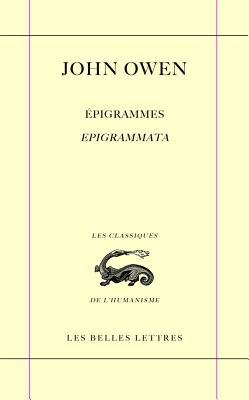
Epigrammes / Epigrammata
by John Owen
English summary: This collection provides the first complete side-by-side Latin and French translation of the Epigrams of John Owen (1564-1622). Presented alongside an introduction that examines the historical and cultural context of the work itself, this collection highlights the author's intellectual and spiritual choices. In the often restricted realm of moral satire, Owen used the genre of epigrams in a novel and, indeed, influential way. French description: Il est difficile d'imaginer aujourd'hui la vogue dont jouirent pendant plusieurs siecles les Epigrammes de John Owen (1564-1622), qui en leur temps firent saluer leur auteur comme le Martial anglais, le second Martial, Martial ressuscite. Plus exclusivement intellectuel que son modele latin, Owen n'eut jamais sa richesse de dons, ni son puissant realisme, ni inversement sa grace et sa tendresse, ni ses raffinements d'artiste. Mais dans le domaine volontairement restreint de la satire morale et dans le cadre etroit du distique, son instrument privilegie, il porte l'epigramme a un point d'achevement qui ne devait plus etre egale: jamais l'epigramme n'a ete aussi proche de la maxime au sens que lui donnera bientot notre La Rochefoucauld et avec laquelle elle partage le brillant et l'etincelante nettete. Le propos est exclusivement celui d'un moraliste. Observateur fin et spirituel du train du monde, Owen livre son experience en une multitude de traits caustiques qui fusent dans toutes les directions: egratignant les caracteres et les ages, insistant sur les travers de quelques professions et conditions (juristes, medecins, theologiens, courtisans); quelques traits aceres contre le sexe faible et les inconvenients du mariage pourraient le faire soupconner de misogynie si le sujet etait original. En tout cela, nulle illusion, mais nulle mechancete; pas d'attaque personnelle, seulement les defauts universels de la nature humaine; quelques remarques sont plus directement inspirees par des sujets d'actualite: loyal sujet anglais a l'epoque du complot de la poudre a fusil, Owen decoche quelques pointes a l'adresse de l'eglise catholique, il intervient malicieusement a propos de la querelle du vide. Une sagesse ironique se degage, qui fait comprendre aisement l'influence qu'il exerca sur l'age classique, habitue a privilegier l'analyse morale.. Le premier volume des epigrammes, dedie a Lady Neville, a paru en 1606; encourage par son succes immediat, Owen publia l'annee suivante un second volume, dedie a une Stuart; les troisieme et quatrieme volumes parurent en 1612 et 1613: en tout, dix livres d'epigrammes dont l'edition d'ensemble sera publiee en 1622, l'annee meme de sa mort. Une editio locupletior et emendatior a ete publiee a Paris en 1794 par Antoine Augustin Renouard. Premier a ouvrir notre collection a l'humanisme du Nord, Sylvain Durand nous offre dans ce volume le texte et la premiere traduction francaise integrale de cette oeuvre. Executee avec une parfaite exactitude, une aisance et un plaisir evident et meme quelque gourmandise, cette traduction nous est offerte dans une prose serree, quand elle n'accueille pas la coquetterie d'une traduction rythmee. L'edition bilingue est, comme dans tous les volumes de la collection, precedee d'une introduction, cinq grandes parties progressant de la biographie et du contexte historique et culturel a l'oeuvre elle-meme, analysee ensuite dans son aspect formel (le travail sur la matiere des mots, feu d'artifice et fete etourdissante du langage) et dans les liens qu'elle entretient avec l'actualite et la societe de son temps, enfin et plus profondement, avec les options intellectuelles et spirituelles de son auteur.
BUY NOW
Hardcover, 1760 pages
Published April 22nd 2016 by Les Belles Lettres



Grupo de marcas


















© 2026 Bibleportal.com Reservados todos los derechos.
John Owen (1616 - 1683)
Read freely text sermons and articles by the speaker John Owen in text and pdf format.John Owen, called the “prince of the English divines,” “the leading figure among the Congregationalist divines,” “a genius with learning second only to Calvin’s,” and “indisputably the leading proponent of high Calvinism in England in the late seventeenth century,” was born in Stadham (Stadhampton), near Oxford. He was the second son of Henry Owen, the local Puritan vicar. Owen showed godly and scholarly tendencies at an early age. He entered Queen’s College, Oxford, at the age of twelve and studied the classics, mathematics, philosophy, theology, Hebrew, and rabbinical writings. He earned a Bachelor of Arts degree in 1632 and a Master of Arts degree in 1635. Throughout his teen years, young Owen studied eighteen to twenty hours per day.Pressured to accept Archbishop Laud’s new statutes, Owen left Oxford in 1637. He became a private chaplain and tutor, first for Sir William Dormer of Ascot, then for John Lord Lovelace at Hurley, Berkshire. He worked for Lovelace until 1643. Those years of chaplaincy afforded him much time for study, which God richly blessed. At the age of twenty-six, Owen began a forty-one year writing span that produced more than eighty works. Many of those would become classics and be greatly used by God.
Owen was by common consent the weightiest Puritan theologian, and many would bracket him with Jonathan Edwards as one of the greatest Reformed theologians of all time.
Born in 1616, he entered Queen's College, Oxford, at the age of twelve and secured his M.A. in 1635, when he was nineteen. In his early twenties, conviction of sin threw him into such turmoil that for three months he could scarcely utter a coherent word on anything; but slowly he learned to trust Christ, and so found peace.
In 1637 he became a pastor; in the 1640s he was chaplain to Oliver Cromwell, and in 1651 he was made Dean of Christ Church, Oxford's largest college. In 1652 he was given the additional post of Vice-Chancellor of the University, which he then reorganized with conspicuous success. After 1660 he led the Independents through the bitter years of persecution till his death in 1683.
John Owen was born of Puritan parents at Stadham in Oxfordshire in 1616. At Oxford University, which he entered in 1628 at twelve years of age, John pored over books so much that he undermined his health by sleeping only four hours a night. In old age he deeply regretted this misuse of his body, and said he would give up all the additional learning it brought him if only he might have his health back. Naturally, he studied the classics of the western world, but also Hebrew, the literature of the Jewish rabbis, mathematics and philosophy. His beliefs at that time were Presbyterian, however, his ambition, although fixed on the church, was worldly.
John was driven from Oxford in 1637 when Archbishop Laud issued rules that many of England's more democratically-minded or "low" church ministers could not accept. After this, John was in deep depression. He struggled to resolve religious issues to his satisfaction. While in this state, he heard a sermon on the text "Why are you fearful, O you of little faith?" which fired him with new decisiveness.
After that, John wrote a rebuke of Arminianism (a mild form of Calvinism which teaches that man has some say in his own salvation or damnation although God is still sovereign). Ordained shortly before his expulsion from Oxford, he was given work at Fordham in Essex. After that he rose steadily in public affairs. Before all was over, he would become one of the top administrators of the university which expelled him and he even sat in Parliament.
He became a Congregationalist (Puritan) and took Parliament's side in the English Civil Wars. Oliver Cromwell employed him in positions of influence and trust, but John would not go along when Cromwell became "Protector." Nonetheless, many of Parliament's leaders attended John's church.
John's reputation was so great that he was offered many churches. One was in Boston, Massachusetts. John turned that down, but he once scolded the Puritans of New England for persecuting people who disagreed with them.
He also engaged in controversy with such contemporaries as Richard Baxter and Jeremy Taylor. Through it all, John focused his teaching on the person of Christ. "If Christ had not died," he said, "sin had never died in any sinner unto eternity." In another place he noted that "Christ did not die for any upon condition, if they do believe; but he died for all God's elect, that they should believe."
John wrote many books including a masterpiece on the Holy Spirit. Kidney stones and asthma tormented him in his last years. But he died peacefully in the end, eyes and hands lifted up as if in prayer.
... Show more