John Wesley (along with his brother Charles) is widely credited with the start of the Methodist movement. There is no doubt that his contribution to the Christian world is marked and enduring. He is quoted as having rode 250,000 miles on horseback, preached 40,00 sermons and given away £30,000.
As well as this contribution in the form of financial giving and the spoken word, Wesley, made an impact through the written word. One of his most renowned works is his “Notes on the Bible”. This is a commentary on the each book in the Bible.
Generally this is found in one single, large volume. As a Kindle file this is large and ultimately unwieldy. To help in this we have taken each book of the Bible and present it as a one Kindle book.
This helps you manage your commentaries on your Kindle and also allows you to keep an eye on the amount of space taken up in its memory.
Coupled with an active table of contents this is one of the easiest to use versions of Wesley’s work.
As a commentary the value of John Wesley’s contribution must not be underestimated. His writing is doctrinal but not dogmatic. He shines new light on various passages but all the time remaining true to the biblical meaning.
This book provides his commentary on:
• Ezra
• Nehemiah
• Esther
As part of this publication there is an extensive study guide designed to help you in your quest to better study the Bible.
➢ Study Guide
➢ A Secret Of Understanding The Bible
➢ The Quick Way To Get To Understand Different Types Of Bible Books
➢ Understanding The Bible By Grasping The Big Picture
➢ 4 Essential Tips For Developing An Organised Approach To Understanding The Bible
➢ The Authority Of The Bible
➢ The Theme Of The Bible
➢ The Impact Of The Bible On Our Lives
➢ Practical Help
➢ How To Study The Bible

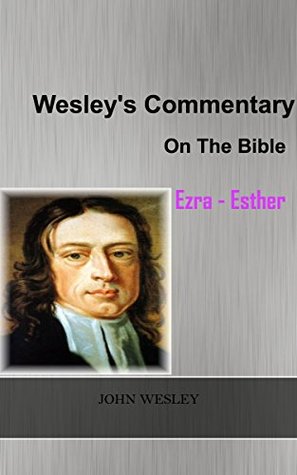





















John Wesley (1703 - 1791)
Was an Anglican cleric and Christian theologian. Wesley is largely credited, along with his brother Charles Wesley, as founding the Methodist movement which began when he took to open-air preaching in a similar manner to George Whitefield. In contrast to Whitefield's Calvinism, Wesley embraced the Arminian doctrines that were dominant in the 18th-century Church of England. Methodism in both forms became a highly successful evangelical movement in Britain, which encouraged people to experience Jesus Christ personally.Wesley helped to organise and form societies of Christians throughout Great Britain, North America and Ireland as small groups that developed intensive, personal accountability, discipleship and religious instruction among members. His great contribution was to appoint itinerant, unordained preachers who travelled widely to evangelise and care for people in the societies. Under Wesley's direction, Methodists became leaders in many social issues of the day, including the prison reform and abolitionism movements.
John Wesley was an Anglican cleric and Christian theologian. Wesley is largely credited, along with his brother Charles Wesley, with founding the Methodist movement which began when he took to open-air preaching in a similar manner to George Whitefield. In contrast to George Whitefield's Calvinism (which later led to the forming of the Calvinistic Methodists), Wesley embraced Arminianism. Methodism in both forms was a highly successful evangelical movement in the United Kingdom, which encouraged people to experience Christ personally.
Wesley believed that this doctrine should be constantly preached, especially among the people called Methodists. In fact, he contended that the purpose of the Methodist movement was to "spread scriptural holiness across England."
Throughout his life, Wesley remained within the Church of England and insisted that his movement was well within the bounds of the Anglican tradition. His maverick use of church policy put him at odds with many within the Church of England, though toward the end of his life he was widely respected.
John Wesley was the founder of the Methodist movement which grew from the 'Holy Club' of his Oxford friends into a great religious revival. An indefatigable traveller, preacher and writer, Wesley averaged 8,000 miles a year on horseback and gave 15 sermons a week. The reluctance of the Anglican clergy to lend him their pulpits led him to give some of his sermons in the open air, a decision which enabled him to reach those among the poorer sections of society who were not accustomed to going to church.
... Show more