A discourse delivered before a council of the whole North African Episcopate assembled at Hippo-Regius.
Introductory Notice
The occasion and date of the composition of this treatise are indicated in a statement which Augustine makes in the seventeenth chapter of the First Book of his Retractations.
From this we learn that, in its original form, it was a discourse which Augustine, when only a presbyter, was requested to deliver in public by the bishops assembled at the Council of Hippo-Regius, and that it was subsequently issued as a book at the desire of friends. The general assembly of the North African Church, which was thus convened at what is now Bona, in the modern territory of Algiers, took place in the year 393 A.D., and was otherwise one of some historical importance, on account of the determined protest which it emitted against the position elsewhere allowed to Patriarchs in the Church, and against the admittance of any more authoritative or magisterial title to the highest ecclesiastical official than that of simply "Bishop of the first Church" (primæ sedis episcopus).
The work constitutes an exposition of the several clauses of the so-called Apostles' Creed. The questions concerning the mutual relations of the three Persons in the Godhead are handled with greatest fullness; in connection with which, especially in the use made of the analogies of Being, Knowledge, and Love, and in the cautions thrown in against certain applications of these and other illustrations taken from things of human experience, we come across sentiments which are also repeated in the City of God, the books on the Trinity, and others of his doctrinal writings.

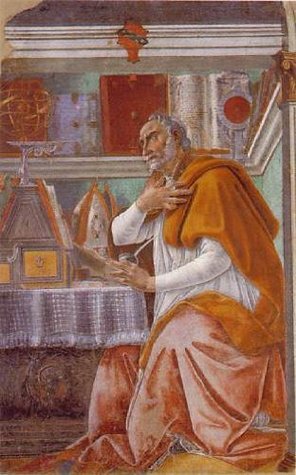





















Aurelius Augustinus - more commonly "St. Augustine of Hippo," or simply "Augustine" - was a philosopher and theologian, and one of the most important figures in the development of Western Christianity. He framed the concepts of original sin and just war. Augustine was one of the most prolific Latin authors in terms of surviving works, and the list of his works consists of more than a hundred separate titles.
Augustine took the view that the Biblical text should not be interpreted literally if it contradicts what we know from science and our God-given reason. Many Protestants, especially Calvinists, consider him to be one of the theological fathers of Reformation teaching on salvation and divine grace.
... Show more