
- Bíblia
- Leia a Bíblia
- Versões da Bíblia
- Verso do dia
- Planos de Leitura
- Versos por Tópico
- Books of the Bible
- Imagens bíblicas
- Estude
- Comentários
- Concordâncias
- Dicionários
- Enciclopédias
- Sermões
- Bible Atlas & Maps
- BP Wiki
- Devocionais
- Devocionais de hoje
- Light of the World
- Todos os devocionais
- Inspirational Quotes
- Mais
- Picture Quotes
- Videos
- Inspirador
- Estudo da Bíblia
- O que a Bíblia diz
- Bible Q&As
- Daily Bread
- Bible by Genre
- Bible Stories
- Random Bible Verse
- Comunidade
- Store
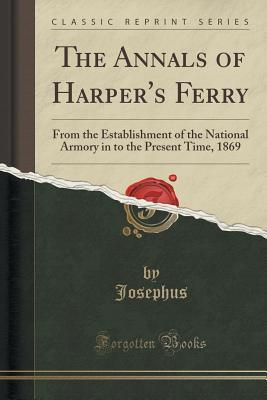
The Annals of Harper's Ferry: From the Establishment of the National Armory in to the Present Time, 1869 (Classic Reprint)
by Flavius Josephus
Excerpt from The Annals of Harper's Ferry: From the Establishment of the National Armory in to the Present Time, 1869
In 1794, during the administration of General Washington, it was chosen as the site of a National Armory. It is said that the Great Father of his conntrv himself suggested it as the location, having visited the place in person. This is a tradition of the place, and if it be true, it is characteristic of the most sagacious of men The water power is immense, some people supposing it to be the finest in the veild. The Valley of Virginia and that of Middletown, as well as the fertile plains of Loudoun, gave promise of an abundance of the necessaries of life, and perhaps with the eye of prophecy he saw Rail Roads penetrating the bowels of the Alleghanies, and transporting their then hidden mineral treasures to aid in the proposed manufacture. In the year above mentioned Congress applied to the General Assembly of Virginia for permission to purchase the site, and by a vote of the latter permission was granted to purchase a tract not exceed ing six hundred and forty acres. Accordingly a body of land containing one hundred and twenty-five acres was purchased from the heirs of Mr. Harper, a former proprietor, from whom the place takes its name. This tract is contained in a triangle formed by the two rivers and a line running from river to river along what is called Union Street. Another purchase was made of three hundred and ten acres from a Mr. Rutherford. This tract is that on which the village of Bolivar now stands. In some time after, Congress, desiring to obtain the benefit of the fine timber growing on the Loudoun Heights, and not deeming it proper to ask any further grants from the State of Virginia leased in perpetuity of Lord Fairfax, proprietor of the Northern Neck, the right to all the timber growing and to grow on a tract of thiiteen hundred and ninety five aci es on the Loudoun Heights, immediately adjoining Haiflpeis sferry.
About the Publisher
Forgotten Books publishes hundreds of thousands of rare and classic books. Find more at www.forgottenbooks.comwww.forgottenbooks.com
This book is a reproduction of an important historical work. Forgotten Books uses state-of-the-art technology to digitally reconstruct the work, preserving the original format whilst repairing imperfections present in the aged copy. In rare cases, an imperfection in the original, such as a blemish or missing page, may be replicated in our edition. We do, however, repair the vast majority of imperfections successfully; any imperfections that remain are intentionally left to preserve the state of such historical works.
In 1794, during the administration of General Washington, it was chosen as the site of a National Armory. It is said that the Great Father of his conntrv himself suggested it as the location, having visited the place in person. This is a tradition of the place, and if it be true, it is characteristic of the most sagacious of men The water power is immense, some people supposing it to be the finest in the veild. The Valley of Virginia and that of Middletown, as well as the fertile plains of Loudoun, gave promise of an abundance of the necessaries of life, and perhaps with the eye of prophecy he saw Rail Roads penetrating the bowels of the Alleghanies, and transporting their then hidden mineral treasures to aid in the proposed manufacture. In the year above mentioned Congress applied to the General Assembly of Virginia for permission to purchase the site, and by a vote of the latter permission was granted to purchase a tract not exceed ing six hundred and forty acres. Accordingly a body of land containing one hundred and twenty-five acres was purchased from the heirs of Mr. Harper, a former proprietor, from whom the place takes its name. This tract is contained in a triangle formed by the two rivers and a line running from river to river along what is called Union Street. Another purchase was made of three hundred and ten acres from a Mr. Rutherford. This tract is that on which the village of Bolivar now stands. In some time after, Congress, desiring to obtain the benefit of the fine timber growing on the Loudoun Heights, and not deeming it proper to ask any further grants from the State of Virginia leased in perpetuity of Lord Fairfax, proprietor of the Northern Neck, the right to all the timber growing and to grow on a tract of thiiteen hundred and ninety five aci es on the Loudoun Heights, immediately adjoining Haiflpeis sferry.
About the Publisher
Forgotten Books publishes hundreds of thousands of rare and classic books. Find more at www.forgottenbooks.comwww.forgottenbooks.com
This book is a reproduction of an important historical work. Forgotten Books uses state-of-the-art technology to digitally reconstruct the work, preserving the original format whilst repairing imperfections present in the aged copy. In rare cases, an imperfection in the original, such as a blemish or missing page, may be replicated in our edition. We do, however, repair the vast majority of imperfections successfully; any imperfections that remain are intentionally left to preserve the state of such historical works.
BUY NOW
Paperback, 70 pages
Published November 15th 2018 by Forgotten Books (first published August 4th 2015)
Se inscrever
Obtenha o versículo bíblico diário todos os dias na sua caixa de entrada!
Leia no celular



Grupo de Marcas


















© 2025 Bibleportal.com Todos os direitos reservados.
Flavius Josephus was born Joseph ben Mattathias in Jerusalem in 37 CE a few years after the time of Jesus, during the time of the Roman occupation of the Jewish homeland. In his early twenties he was sent to Rome to negotiate the release of several priests held hostage by Emperor Nero. When he returned home after completing his mission he found the nation beginning a revolution against the Romans.
Despite his foreboding that the cause was hopeless, he was drafted into becoming commander of the revolutionary forces in Galilee, where he spent more time controlling internal factions than fighting the Roman army. When the city of Jotapata he was defending fell to the Roman general Vespasian, Josephus and his supporters hid in a cave and entered into a suicide pact, which Josephus oddly survived.
Taken prisoner by Vespasian, Josephus presented himself as a prophet. Noting that the war had been propelled by an ancient oracle that foretold a world ruler would arise from Judaea, Josephus asserted that this referred to Vespasian, who was destined to become Emperor of Rome. Intrigued, Vespasian spared his life. When this prophecy came true, and Vespasian became Emperor, he rewarded Josephus handsomely, freeing him from his chains and eventually adopting him into his family, the Flavians. Josephus thus became Flavius Josephus.
During the remainder of the war, Josephus assisted the Roman commander Titus, Vespasian's son, with understanding the Jewish nation and in negotiating with the revolutionaries. Called a traitor, he was unable to persuade the defenders of Jerusalem to surrender to the Roman siege, and instead became a witness to the destruction of the city and the Holy Temple.
Living at the Flavian court in Rome, Josephus undertook to write a history of the war he had witnessed. The work, while apparently factually correct, also served to flatter his patron and to warn other provinces against the folly of opposing the Romans. He first wrote in his native language of Aramaic, then with assistance translated it into Greek (the most-used language of the Empire). It was published a few years after the end of the war, in about 78 CE. He was about 40 years old.
Josephus subsequently improved his language skills and undertook a massive work in Greek explaining the history of the Jews to the general non-Jewish audience. He emphasized that the Jewish culture and Bible were older than any other then existing, hence called his work the Jewish Antiquities. Approximately half the work is a rephrasing of the Hebrew Bible, while much of the rest draws on previous historians. This work was published in 93 or 94 CE, when he was about 56 years old.
Josephus wrote at least two smaller books, including his autobiography, in which he recounts his life from birth until the writing of the Antiquities. The year he died is unknown.
... Show more