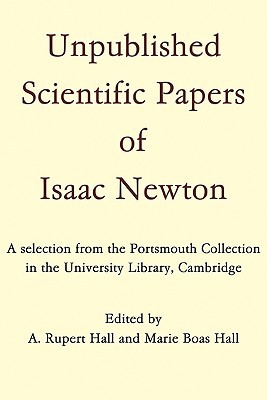
First published in 1962, this volume collects together some of Newton's most important scientific papers. Chosen primarily to illustrate Newton's ideas on the nature of matter, the papers afford valuable insights into Newton's development as a scientist and his ideas of the world that science explores. The six sections are entitled: Mathematics, Mechanics, Theory of Matter, Manuscripts related to the Principia, Education and Notes. Each section has a critical introduction to set the manuscripts in perspective and to discuss their implications. English translations of the Latin documents are given.






















Sir Isaac Newton was an English physicist, mathematician, astronomer, natural philosopher, alchemist, and theologian who is considered one of the most influential people in human history.
Newton remains influential to scientists, as demonstrated by a 2005 survey of scientists in Britain's Royal Society asking who had the greater effect on the history of science, Newton or Albert Einstein. Newton was deemed the more influential.[8]
Newton also wrote on Judaeo-Christian prophecy, whose decipherment was essential, he thought, to the understanding of God. His book on the subject, which was reprinted well into the Victorian Age, represented lifelong study. Its message was that Christianity went astray in the 4th century AD, when the first Council of Nicaea propounded erroneous doctrines of the nature of Christ. The full extent of Newton's unorthodoxy was recognized only in the present century: but although a critic of accepted Trinitarian dogmas and the Council of Nicaea, he possessed a deep religious sense, venerated the Bible and accepted its account of creation. In late editions of his scientific works he expressed a strong sense of God's providential role in nature.
... Show more