John Calvin’s dedication to preaching verse by verse through the Bible was impressive. He was a firm believer in preaching from the original language, in the historical-grammatical approach, with application to the hearer. What is even more amazing is to see the shear number of sermons he preached on various books of the Bible:
Calvin’s method of preaching is well-documented: it was consecutive, expositional preaching through various books of the Bible. He would begin in verse 1, chapter 1 of a particular book and then preach through the book until the end. The next sermon would begin a new book, and he would preach that book sequentially until finished. This is serial preaching at its best. Calvin’s immediate movement to preach one book after another is what Gerstner calls ‘chain preaching.’ He spent, for example, one year preaching through Job, a year and a half on Deuteronomy (200 sermons), and three years on Isaiah (350 sermons).
As mentioned, John Calvin preached 200 sermons on Deuteronomy. They have been dropped down the memory hole. In 1583, a translation of them appeared in English. This was ignored, then forgotten.Over four centuries later (1987), the Banner of Truth Trust reprinted an English edition, which was barely readable in 1583, and was worse in the facsimile copy. Today, a used copy sells for $100 or more.
Recently this was put into the public domain. A dedicated woman voluntarily proofed the digital text, and then produced clean copy. The public can now read these sermons, which have been ignored for 450 years. I want people to know about these remarkable documents.
A big thank you to Lionel Dyck who helped me clean up the public domain copy and make it into an eBook.

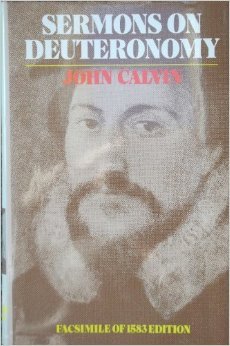





















John Calvin (1509 - 1584)
Was an influential French theologian and pastor during the Protestant Reformation. He was a principal figure in the development of the system of Christian theology later called Calvinism. Originally trained as a humanist lawyer, he broke from the Roman Catholic Church around 1530. After religious tensions provoked a violent uprising against Protestants in France, Calvin fled to Basel, Switzerland, where he published the first edition of his seminal work The Institutes of the Christian Religion in 1536.Calvin's writing and preachings provided the seeds for the branch of theology that bears his name. The Reformed, Congregational, and Presbyterian churches, which look to Calvin as the chief expositor of their beliefs, have spread throughout the world.
John Calvin was an influential French theologian and pastor during the Protestant Reformation. He was a principal figure in the development of the system of Christian theology later called Calvinism. Originally trained as a humanist lawyer, he broke from the Roman Catholic Church around 1530. After religious tensions provoked a violent uprising against Protestants in France, Calvin fled to Basel, Switzerland, where in 1536 he published the first edition of his seminal work Institutes of the Christian Religion.
Calvin's writing and preaching provided the seeds for the branch of theology that bears his name. The Presbyterian and other Reformed churches, which look to Calvin as a chief expositor of their beliefs, have spread throughout the world. Calvin's thought exerted considerable influence over major religious figures and entire religious movements, such as Puritanism, and some have argued that his ideas have contributed to the rise of capitalism, individualism, and representative democracy in the West.
Founder of Calvinism. John Calvin, a French scholar who became a leading preacher and dominant force in the Reformation of the 16th Century, studied at the University of Paris and at the University of Orleans. He became dissatisfied with the teachings of the Roman Catholic Church and allied himself with the cause of the Protestant Reformation in 1532.
When the king of France decided to settle the religious question in his country in favor of the Catholics, Calvin fled to Geneva, Switzerland, where his writings and lectures made Geneva the Rome of Protestantism. His institutes of the Christian religion became the basis for the Presbyterian way of thought and church life. Calvinism is the main doctrine of the Presbyterian and Reformed Churches.
... Show more