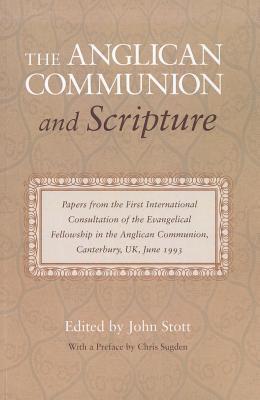
""For the Church, the Bible is an authority that talks about morality; but the (western) culture accepts neither authority nor morality . . . The Church must challenge the modem world to enter the world of the Bible, and must place the culture of modernism in the spotlight of the Bible"" (Summau Findings Report, Canterbury 1993). What does the Bible say about the authority of scripture? What links the Holy Spirit and the Holy Bible? How does scripture inform the witness of the exploding Church in Tanzania and of a struggling congregation in a religiously plural inner city in the UK? Can a Toronto church use the Bible to address the issue of homosexuality? How does a bishop use scripture to reform the structure of his diocese in South Africa or to address national injustice in Kenya? And is there a particular Anglican view of scripture to contribute to the ecumenical debate? In June 1995, the Evangelical Fellowship in the Communion held its first international consultation in its thirty-two year history ""to commend and strengthen biblical authority in the life of the church."" This book captures the findings of the consultation, Bible studies on biblical authority and case studies on the use of scripture in mission. The international team of contributors comprises of John Stott (UK), Vinay Samuel (India), Michael Nazir-Ali (Pakistan), Mdimi Mhogolo (Tanzania), Margaret Rodgers (Australia), Peter Moore (Canada), Philip Le Feuvre (South Africa) and Alfredo Cooper (Chile), along with Graham Kings, Cyril Okorocha, Elaine Storkey, Jesudasan Jeyaraj, Chris Wright, Ida Glaser and Paddy Benson. ""A ringing statement of mainstream Anglican Evangelical attitudes to the Bible . . ."" Church Times, England






















John Robert Walmsley Stott is a British Christian leader and Anglican clergyman who is noted as a leader of the worldwide evangelical movement. He is famous as one of the principal authors of the Lausanne Covenant in 1974.
Stott was ordained in 1945 and went on to become a curate at All Souls Church, Langham Place (1945-1950) then rector (1950-75). This was the church in which he had grown up, and in which he has spent almost all of his life, aside from a few years spent in Cambridge.
Stott played a central role at two landmark events in the history of British evangelicalism. He was chairing the National Assembly of Evangelicals in 1966, a convention organised by the Evangelical Alliance, when Martyn Lloyd-Jones made an unexpected call for evangelicals to unite together as evangelicals and no longer within their 'mixed' denominations.
... Show more