C.H. Spurgeon said, "Those great preachers whose names we remember, were men who counted nothing their own: they were driven out from their benefices, because they could not conform to the Established Church, and they gave up all they had willingly to the Lord. They were hunted from place to place, they wandered here and there to preach the gospel to a few. Those were foul times; but they promised they would walk the road fair or foul, and they did walk it knee-deep in mud; and they would have walked it if it had been kinee-deep in blood too. But now we are all little men, there is scarce a man alive now upon this earth." Iain Murray added, "The atmosphere of that day was electric and charged with emotion; the popular discontent was great and strong guards stood ready in London, but these sermons seem far removed from all that. There is a calmness, and unction and a lack of invective. Great though their sorrow was for their flocks and for their nation, they had a message to preach which was more than equal to the strain of the crisis. An eternal God, an Ever-Living Saviour and a glorious hope of heaven, carried them through this heaviest trial."

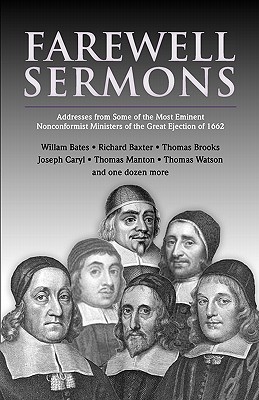





















He wrote 168 or so separate works -- such treatises as the Christian Directory, the Methodus Theologiae Christianae, and the Catholic Theology, might each have represented the life's work of an ordinary man. His Breviate of the Life of Mrs Margaret Baxter records the virtues of his wife, and reveals Baxter's tenderness of nature. Without doubt, however, his most famous and enduring contribution to Christian literature was a devotional work published in 1658 under the title Call to the Unconverted to Turn and Live. This slim volume was credited with the conversion of thousands and formed one of the core extra-biblical texts of evangelicalism until at least the middle of the nineteenth century.
Richard Baxter was ordained into the Church of England, 1638, but in two years allied with Puritans opposed to the episcopacy of his church. At Kidderminster (1641-60) he made the church a model parish. The church was enlarged to hold the crowds. Pastoral counseling was as important as preaching, and his program for his parish was a pattern for many other ministers. Baxter played an ameliorative role during the English Civil Wars.
He was a chaplain in the parliamentary army but then helped to restore the king (1660). After the establishment of the monarchy, he fought for toleration of moderate dissent in the Church of England. Persecuted for more than 20 years and was imprisoned (1685) for 18 months, the Revolution of 1688, replacing James II with William and Mary, brought about an Act of Toleration that freed Baxter to express his opinions.
... Show more