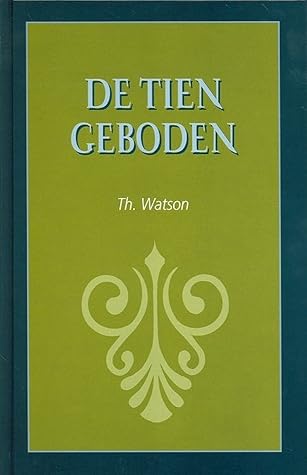
Dit is het tweede deel van Watsons uitleg over de voornaamste hoofdstukken van de leer der waarheid. Het is een vertaling van 'The Ten Commandments', een vervolg op 'A Body of Devinity'. Vóór Watson elk gebod afzonderlijk behandelt, gaat hij uitvoerig in op de gehoorzaamheid aan en de liefde tot Gods geopenbaarde wil en verder op de inleiding van de Wet des HEEREN. De uitleg van elk gebod is helder en ordelijk, waarna verschillende toepassingen volgen die zeer prakticaal zijn. Dit deel heeft daarom ook betekenis voor de christelijke ethiek. Na de behandeling van de Tien Geboden volgen nog korte uiteenzettingen over Het Geloof, De Bekering, De Vruchten van het Gelezen of Gepredikte Woord, De Sacramenten en Het Gebed. Evenals de nadere verhandelingen over de geloofsleer is dit werk bijzonder geschikt ter voorbereiding op de prediking en de catechese.






















He was educated at Emmanuel College, Cambridge, where he was noted for remarkably intense study. In 1646 he commenced a sixteen year pastorate at St. Stephen's, Walbrook. He showed strong Presbyterian views during the civil war, with, however, an attachment to the king, and in 1651 he was imprisoned briefly with some other ministers for his share in Christopher Love's plot to recall Charles II of England.
He was released on 30 June 1652, and was formally reinstated as vicar of St. Stephen's Walbrook. He obtained great fame and popularity as a preacher until the Restoration, when he was ejected for nonconformity. Not withstanding the rigor of the acts against dissenters, Watson continued to exercise his ministry privately as he found opportunity. Upon the Declaration of Indulgence in 1672 he obtained a license to preach at the great hall in Crosby House. After preaching there for several years, his health gave way, and he retired to Barnston, Essex, where he died suddenly while praying in secret. He was buried on 28 July 1686.
Thomas Watson was an English, non-conformist, Puritan preacher and author.
He was educated at Emmanuel College, Cambridge, where he was noted for remarkably intense study. In 1646 he commenced a sixteen year pastorate at St. Stephen's, Walbrook. He showed strong Presbyterian views during the civil war, with, however, an attachment to the king, and in 1651 he was imprisoned briefly with some other ministers for his share in Christopher Love's plot to recall Charles II of England.
He was released on 30 June 1652, and was formally reinstated as vicar of St. Stephen's Walbrook. He obtained great fame and popularity as a preacher until the Restoration, when he was ejected for nonconformity. Not withstanding the rigor of the acts against dissenters, Watson continued to exercise his ministry privately as he found opportunity. Upon the Declaration of Indulgence in 1672 he obtained a license to preach at the great hall in Crosby House. After preaching there for several years, his health gave way, and he retired to Barnston, Essex, where he died suddenly while praying in secret. He was buried on 28 July 1686.
... Show more