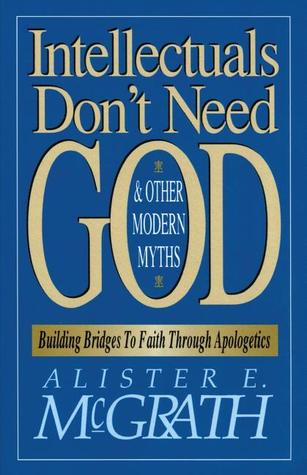
Intellectuals Don't Need God is for people who are not convinced by the arguments of classical, rationalistic apologetics, for people who feel that Christianity must have a broader appeal that to reason alone if it is to be persuasive to non-Christians. Alister McGrath shows convincingly that reason is only one of many possible points of contact between the non-Christian and the gospel. In today's world, nonrational concerns -- such as a sense that life lacks focus, an unconscious fear of death, a deep sense of longing for something unknown we don’t have but know we need -- are much more effective points of contact for apologetics. In this book, Dr. McGrath (who is both a theologian and a scientist with a Ph.D. in microbiology) combines the clarity of a brilliant scientific mind with a deep commitment to Christ and to reaching non-Christians. Intellectuals Don't Need God is for anyone who has questions about the validity of Christianity as well as for students, pastors, and lay leaders. Anyone who works with students and young people especially needs to read this book. As McGrath says, "apologetics is not about winning arguments -- it is about bringing people to Christ."






















Alister Edgar McGrath is a Christian theologian and apologist, who holds both a PhD (in molecular biophysics) and an earned Doctor of Divinity degree from Oxford. He is noted for his work in historical, systematic and scientific theology. He was formerly an atheist.
In his writing and public speaking, he promotes "scientific theology" and opposes antireligionism. McGrath was until recently Professor of Historical Theology at the University of Oxford, but has now taken up the chair of Theology, Religion and Culture at King's College London since September 2008. Until 2005, he was principal of Wycliffe Hall.
McGrath is a prolific writer. His work often refers both to the early Church Fathers and to contemporary evangelical stalwarts such as Thomas Torrance and J. I. Packer. His areas of expertise include doctrine, Church history, the interaction of science and faith, and evangelical spirituality.
In 2005 he resigned as Principal of Wycliffe Hall, whilst remaining President of the Oxford Centre for Christian Apologetics which was based there.
... Show more