
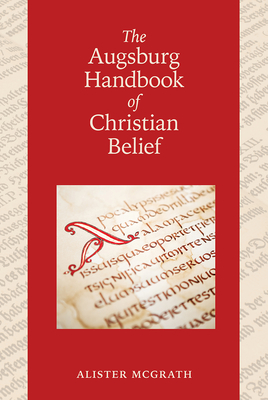
The Augsburg Handbook of Christian Belief
by Alister McGrath
The Augsburg Handbook of Christian Belief brings together six essays from expert contributors, covering the topics of faith, God, Jesus, salvation, the church, and Christian hope. Together, these essays form a sweeping survey of the basic principles, questions, and traditions of Christianity. Complete with a brief introduction on the history of Christian thought and an anthology of extracts from major Christian thinkers, this handbook is the ideal companion for both the general reader and the theology scholar. In addition, special boxed features highlight subjects related to each chapter, from the effects of postmodernism on the church, to Jesus's attitude toward women, to the debate over the baptism of children. Whether read from start to end or referenced by topic, this accessible and comprehensive guide to Christian belief provides insight and clarity into how Christians have come to believe what they believe, with a careful attention to the breadth of belief that continues to define the church today.
BUY NOW
Paperback, 445 pages
Published May 9th 2019 by Augsburg Books



品牌集团


















© 2025 Bibleportal.com 版权所有.
Alister Edgar McGrath is a Christian theologian and apologist, who holds both a PhD (in molecular biophysics) and an earned Doctor of Divinity degree from Oxford. He is noted for his work in historical, systematic and scientific theology. He was formerly an atheist.
In his writing and public speaking, he promotes "scientific theology" and opposes antireligionism. McGrath was until recently Professor of Historical Theology at the University of Oxford, but has now taken up the chair of Theology, Religion and Culture at King's College London since September 2008. Until 2005, he was principal of Wycliffe Hall.
McGrath is a prolific writer. His work often refers both to the early Church Fathers and to contemporary evangelical stalwarts such as Thomas Torrance and J. I. Packer. His areas of expertise include doctrine, Church history, the interaction of science and faith, and evangelical spirituality.
In 2005 he resigned as Principal of Wycliffe Hall, whilst remaining President of the Oxford Centre for Christian Apologetics which was based there.
... Show more