
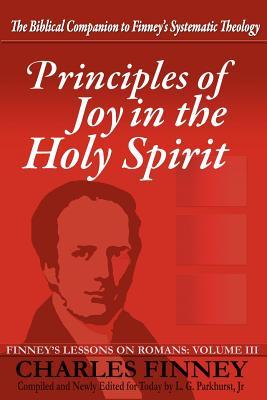
The Letter to the Romans stands as Paul's most significant message on how to begin and maintain a loving relationship with God and others. The Holy Spirit often leads those seeking to understand the essentials of saving and sanctifying faith to read Romans. Beginning with Charles G. Finney's Principles of Righteousness, Volume I, continuing with Principles of Peace, Volume II, and concluding with his Principles of Joy in the Holy Spirit, Volume III, this three-volume set of Finney's Lessons on Romans presents an authoritative collection of Finney's teachings on how to live for Jesus Christ in the power of the Holy Spirit. Finney's Lessons on Romans also provide a solid Biblical foundation for those who want to understand better Finney's Systematic Theology. In this new Finney's Principles Series set, the addition of Study Questions for individuals and groups by the editor and the Commentary on Romans by Henry Cowles, a fellow professor with Finney at Oberlin College, will help you apply and remember the principles contained in Finney's lectures and sermons on Romans. Charles G. Finney became the greatest American preacher and theologian of the Nineteenth-Century. He traveled widely as an evangelist and revivalist in America and abroad, served settled pastorates, taught as a professor of theology, promoted the abolition of slavery and equal rights, and helped found and served as President of Oberlin College in Ohio. Just as one cannot understand the Great Awakening without studying Jonathan Edwards, one cannot understand the great revivals and the theological and social reform movements in Nineteenth-Century America without studying Charles G. Finney. Because Finney's teachings remained true to the Bible and common sense, his message transformed thousands and continues to ring true in the hearts and minds of God's people.
Paperback, 260 pages
Published July 9th 2012 by Agion Press



品牌集团


















© 2025 Bibleportal.com 版权所有.
Charles Grandison Finney was a Presbyterian minister who became an important figure in the Second Great Awakening. His influence during this period was enough that he has been called "The Father of Modern Revivalism".
In addition to becoming a popular Christian evangelist, Finney was involved with the abolitionist movement and frequently denounced slavery from the pulpit.
Finney was known for his innovations in preaching and religious meetings, such as having women pray in public meetings of mixed gender, development of the "anxious seat" (a place where those considering becoming Christians could come to receive prayer), and public censure of individuals by name in sermons and prayers. He was also known for his use of extemporaneous preaching.
No man in his day and generation was more signally blessed of God in winning souls than Charles G. Finney. Thousands and tens of thousands in this and other lands were brought to Christ through his instrumentality. It is hoped that this brief study of his life and labors may stimulate others to renewed effort in seeking to bring men to a saving knowledge of Him who is our Redeemer and Lord.
... Show more