
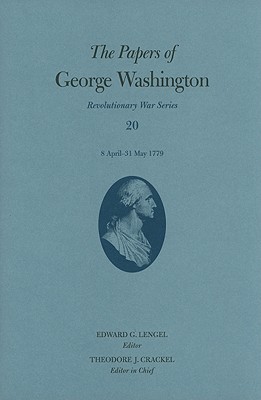
The Papers of George Washington, 20: 8 April-31 May 1779
by George Washington
Volume 20 of the Revolutionary War Series Revolutionary War Series covers 8 April to 31 May 1779. As it begins, Washington is gathering intelligence in preparation for a summer expedition against the Iroquois Confederacy. After considering various intelligence reports compiled with the help of scouts and spies, he issued comprehensive orders to the expedition's commander, Major General John Sullivan, laying out his plan of campaign. At the same time, Washington viewed with concern the worsening situation in the south, where the British had captured Savannah, Georgia, and were pressuring Charleston, South Carolina. His attempts to dispatch reinforcements southward were interrupted, however, by a devastating British raid on Portsmouth, Virginia, in early May.
Washington's development of his espionage network in New York City reaped dividends later that month when one of his spies--a double agent--alerted him ahead of time of a British attack up the Hudson River toward West Point. Thanks to this timely intelligence, Washington prepared his troop dispositions and defenses in advance; and although the British managed to capture King's Ferry, New York, at the end of May, they posed no threat to West Point. Beneath the surface, however, a new and potentially more dangerous threat was brewing: Major General Benedict Arnold, enraged at Washington's inability to clear up Arnold's dispute with Congress and the Government of Pennsylvania, initiated secret contacts with the British.
The publication of this volume has been supported by a grant from the National Historical Publications and Records Commission.
Washington's development of his espionage network in New York City reaped dividends later that month when one of his spies--a double agent--alerted him ahead of time of a British attack up the Hudson River toward West Point. Thanks to this timely intelligence, Washington prepared his troop dispositions and defenses in advance; and although the British managed to capture King's Ferry, New York, at the end of May, they posed no threat to West Point. Beneath the surface, however, a new and potentially more dangerous threat was brewing: Major General Benedict Arnold, enraged at Washington's inability to clear up Arnold's dispute with Congress and the Government of Pennsylvania, initiated secret contacts with the British.
The publication of this volume has been supported by a grant from the National Historical Publications and Records Commission.
BUY NOW
Hardcover, 816 pages
Published August 11th 2010 by University of Virginia Press (first published August 4th 2010)



品牌集团


















© 2025 Bibleportal.com 版权所有.
George Washington was the commander of the Continental Army in the American Revolutionary War (1775-1783) and served as the first President of the United States of America (1789-1797). For his central role in the formation of the United States, he is often referred to as the father of his country.
Washington was baptized into the Church of England. In 1765, when the Church of England was still the state religion, he served on the vestry (lay council) for his local church. Throughout his life, he spoke of the value of righteousness, and of seeking and offering thanks for the "blessings of Heaven."
The Electoral College elected Washington unanimously in 1789, and again in the 1792 election; he remains the only president to receive 100% of the electoral votes.
Washington proved an able administrator. An excellent delegator and judge of talent and character, he held regular cabinet meetings to debate issues before making a final decision. In handling routine tasks, he was "systematic, orderly, energetic, solicitous of the opinion of others but decisive, intent upon general goals and the consistency of particular actions with them.
Washington died in 1799. He has been consistently ranked by scholars as one of the greatest U.S. Presidents.
... Show more