
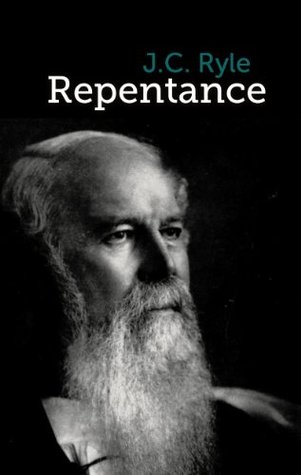
Repentance
by J.C. Ryle
"The tears of repentance wash away no sins. It is bad theology to say that they do. That is the office, that the work of the blood of Christ alone. Contrition makes no atonement for transgression. It is wretched theology to say that it does. It can do nothing of the kind. Our best repentance is a poor, imperfect thing—and needs repenting over again. Our best contrition has defects enough about it to sink us into hell. “We are counted righteous before God only for the sake of our Lord Jesus Christ, by faith, and not for our own works or deservings,” not for our repentance, holiness, almsgiving, sacrament receiving, or anything of the kind. All this is perfectly true.
But still it is no less true that justified people are always penitent people, and that a forgiven sinner will always be a man who mourns over, and loathes his sins. God in Christ is willing to receive rebellious man, and grant him peace, if he only come to Him in Christ’s name however wicked he may have been. But God requires, and requires justly, that the rebel shall throw down his arms. The Lord Jesus Christ is ready to pity, pardon, relieve, cleanse, wash, sanctify, and fit for heaven. But the Lord Jesus Christ desires to see a man hate the sins that he wishes to be forgiven. Let some people call this “legality” if they will. Let some call it “bondage” if they please. I take my stand on Scripture. The testimony of God’s Word is plain and unmistakable. Justified people are always penitent people. Without repentance there is no forgiveness of sins."
But still it is no less true that justified people are always penitent people, and that a forgiven sinner will always be a man who mourns over, and loathes his sins. God in Christ is willing to receive rebellious man, and grant him peace, if he only come to Him in Christ’s name however wicked he may have been. But God requires, and requires justly, that the rebel shall throw down his arms. The Lord Jesus Christ is ready to pity, pardon, relieve, cleanse, wash, sanctify, and fit for heaven. But the Lord Jesus Christ desires to see a man hate the sins that he wishes to be forgiven. Let some people call this “legality” if they will. Let some call it “bondage” if they please. I take my stand on Scripture. The testimony of God’s Word is plain and unmistakable. Justified people are always penitent people. Without repentance there is no forgiveness of sins."
BUY NOW
Kindle Edition, 27 pages
Published November 19th 2012 by Ravenio Books



品牌集团


















© 2026 Bibleportal.com 版权所有.
J.C. Ryle (1816 - 1900)
J.C. Ryle was a prolific writer, vigorous preacher, faithful pastor, husband of three wives, [widowed three times: Matilda died in 1847, Jessie died in 1860, Henrietta died in 1889] and the father to five children [1 with Matilta and 4 with Jessie]. He was thoroughly evangelical in his doctrine and uncompromising in his Biblical principles. In 1880, after 38 years in Pastoral ministry in rural England, at age 64, he became the first Anglican bishop of Liverpool. He retired in 1900 at age 83 and died later the same year at the age of 84.“He [J.C. Ryle] was great through the abounding grace of God. He was great in stature; great in mental power; great in spirituality; great as a preacher and expositor of God’s most holy Word; great in hospitality; great as a writer of Gospel tracts; great as a Bishop of the Reformed Evangelical Protestant Church in England, of which he was a noble defender; great as first Bishop of Liverpool. I am bold to say, that perhaps few men in the nineteenth century did as much for God, for truth, and for righteousness, among the English speaking race, and in the world, as our late Bishop.” - Rev. Richard Hobson, three days after Ryle’s burial in 1900.
John Charles Ryle was the first Anglican bishop of Liverpool. Ryle was a strong supporter of the evangelical school and a critic of Ritualism. Among his longer works are Christian Leaders of the Eighteenth Century (1869), Expository Thoughts on the Gospels (7 vols, 1856-69), Principles for Churchmen (1884).
Thoroughly evangelical in his doctrine and uncompromising in his principles, J.C. Ryle was a prolific writer, vigorous preacher, and faithful pastor.
In his diocese, he exercised a vigorous and straightforward preaching ministry, and was a faithful pastor to his clergy, exercising particular care over ordination retreats. He formed a clergy pension fund for his diocese and built over forty churches. Despite criticism, he put raising clergy salaries ahead of building a cathedral for his new diocese.
Ryle combined his commanding presence and vigorous advocacy of his principles with graciousness and warmth in his personal relations. Vast numbers of working men and women attended his special preaching meetings, and many became Christians.
John Charles Ryle was born at Macclesfield and was educated at Eton and at Christ Church, Oxford. He was a fine athlete who rowed and played Cricket for Oxford, where he took a first class degree in Greats and was offered a college fellowship (teaching position) which he declined. The son of a wealthy banker, he was destined for a career in politics before answering a call to ordained ministry.
He was spiritually awakened in 1838 while hearing Ephesians 2 read in church. He was ordained by Bishop Sumner at Winchester in 1842. After holding a curacy at Exbury in Hampshire, he became rector of St Thomas's, Winchester (1843), rector of Helmingham, Suffolk (1844), vicar of Stradbroke (1861), honorary canon of Norwich (1872), and dean of Salisbury (1880). In 1880, at age 64, he became the first bishop of Liverpool, at the recommendation of Prime Minister Benjamin Disraeli. He retired in 1900 at age 83 and died later the same year.
Ryle was a strong supporter of the evangelical school and a critic of Ritualism. Among his longer works are Christian Leaders of the Eighteenth Century (1869), Expository Thoughts on the Gospels (7 vols, 1856-69) and Principles for Churchmen (1884).
... Show more