
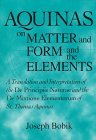
On Matter and Form and the Elements: A Translation & Interpretation of the De Principiis Naturae & the De Mixtione Elementorum
by Thomas Aquinas
In Aquinas on Matter and Form and the ElementsAquinas on Matter and Form and the Elements, Joseph Bobik proceeds, not by taking into account the works of countless scholars, but rather by trying to do some genuine, straightforward, and unencumbered philosophy, using the words of Thomas Aquinas as a point of departure. In parts one and two of this volume, he presents, translates, and offers a readily comprehensible interpretation of Aquinas's De Principiis Naturae De Principiis Naturae and his De Mixtione ElementorumDe Mixtione Elementorum.
Bobik then reflects on what Aquinas says about matter and form and the elements in various contexts and throughout his many works. In part three, Bobik clarifies how, according to Aquinas, composition out of matter and form, on the one hand, and composition out of elements, on the other, relate to one another and to the physical substances in which they are found. He considers the role of the elements in relation to the creative causality of God, and in relation to the generating and sustaining causality of the heavenly bodies. Part four investigates various sources in order to see what thinkers today have to say about the elements, the hope being that today's views and those of Aquinas might shed some helpful and welcome light on one another.
Bobik then reflects on what Aquinas says about matter and form and the elements in various contexts and throughout his many works. In part three, Bobik clarifies how, according to Aquinas, composition out of matter and form, on the one hand, and composition out of elements, on the other, relate to one another and to the physical substances in which they are found. He considers the role of the elements in relation to the creative causality of God, and in relation to the generating and sustaining causality of the heavenly bodies. Part four investigates various sources in order to see what thinkers today have to say about the elements, the hope being that today's views and those of Aquinas might shed some helpful and welcome light on one another.
Paperback, 352 pages
Published March 15th 1998 by University of Notre Dame Press (first published February 1st 1998)
tags: philosophy



品牌集团


















© 2025 Bibleportal.com 版权所有.
Thomas Aquinas was an immensely influential philosopher and theologian in the tradition of scholasticism, known as Doctor Angelicus and Doctor Communis.
He was the foremost classical proponent of natural theology, and the father of the Thomistic school of philosophy and theology. His influence on Western thought is considerable, and much of modern philosophy was conceived as a reaction against, or as an agreement with, his ideas, particularly in the areas of ethics, natural law and political theory.
The philosophy of Aquinas has exerted enormous influence on subsequent Christian theology, especially that of the Roman Catholic Church, extending to Western philosophy in general, where he stands as a vehicle and modifier of Aristotelianism, which he fused with the thought of Augustine.
... Show more