
Quote by Thomas Aquinas

“351. The second reason shows that there is no infinite multitude. For everything countable can be numbered and consequently passed through by counting. But every number and whatever has a number is countable. Therefore, every such thing can be passed over. If, therefore any number, whether separated or existing in sensible things, be infinite, it follows that the infinite can be passed through, which is impossible. 352. Notice that these reasons are probable and proceed from common premises. For they do not conclude of necessity: in effect, whoever posits an infinite body would not concede that it would of its very nature be terminated by a surface, except perhaps potentially; although this is probable and well-known. Similarly, whoever would posit an infinite multitude would not admit it to be a number or that it has a number. For number adds to multitude the notion of measure, because a number is “multitude measured by unity,” as is said in Metaphysics X. For this reason number is considered to be a species of discrete quantity, but multitude is not; it is, rather, a transcendental.”
Be the first to react on this!



品牌集团


















© 2025 Bibleportal.com 版权所有.
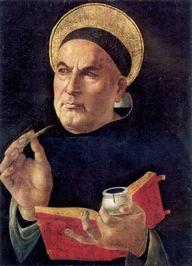
Thomas Aquinas was an immensely influential philosopher and theologian in the tradition of scholasticism, known as Doctor Angelicus and Doctor Communis.
He was the foremost classical proponent of natural theology, and the father of the Thomistic school of philosophy and theology. His influence on Western thought is considerable, and much of modern philosophy was conceived as a reaction against, or as an agreement with, his ideas, particularly in the areas of ethics, natural law and political theory.
The philosophy of Aquinas has exerted enormous influence on subsequent Christian theology, especially that of the Roman Catholic Church, extending to Western philosophy in general, where he stands as a vehicle and modifier of Aristotelianism, which he fused with the thought of Augustine.