
Quote by Thomas Aquinas

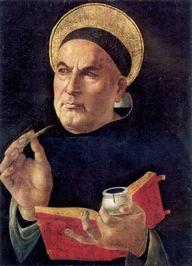
“In ends there is found a twofold order, to wit, the order of intention and the order of execution, and in both orders there must be some first point. That which is first in the order of intention is a sort of principle moving the desire: take that principle away, and desire would have nothing to move it. The moving principle of the execution is that from whence the work begins: take away that moving principle, and none would begin to work at anything. Now the moving principle of the intention is the last end: the moving principle of the execution is the first step in the way of means to the end. Thus, then, on neither side is it possible to go on to infinity: because, if there were no last end, nothing would be desired, nor any action have a term, nor would the intention of the [3] agent rest. On the other hand, if there were no first step in the means to the end, no one would begin to work at anything, and deliberation would never terminate, but go on to infinity.”
Be the first to react on this!



品牌集团


















© 2025 Bibleportal.com 版权所有.
Thomas Aquinas was an immensely influential philosopher and theologian in the tradition of scholasticism, known as Doctor Angelicus and Doctor Communis.
He was the foremost classical proponent of natural theology, and the father of the Thomistic school of philosophy and theology. His influence on Western thought is considerable, and much of modern philosophy was conceived as a reaction against, or as an agreement with, his ideas, particularly in the areas of ethics, natural law and political theory.
The philosophy of Aquinas has exerted enormous influence on subsequent Christian theology, especially that of the Roman Catholic Church, extending to Western philosophy in general, where he stands as a vehicle and modifier of Aristotelianism, which he fused with the thought of Augustine.