
Quote by Ronald Reagan

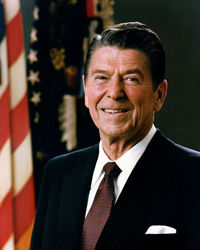
“My assignment as the post’s adjutant and personnel officer (I ended the war a captain) put me in close contact with the civilian bureaucrats and it didn’t take long for me to decide I didn’t think much of the inefficiency, empire building, and business-as-usual attitude that existed in wartime under the civil service system. If I suggested that an employee might be expendable, his supervisor would look at me as if I were crazy. He didn’t want to reduce the size of his department; his salary was based to a large extent on the number of people he supervised. He wanted to increase it, not decrease it. I discovered it was almost impossible to remove an incompetent or lazy worker and that one of the most popular methods supervisors used in dealing with an incompetent was to transfer him or her out of his department to a higher-paying job in another department. We had a warehouse filled with cabinets containing old records that had no use or historic value. They were totally obsolete. Well, with a war on, there was a need for the warehouse and the filing cabinets, so a request was sent up through channels requesting permission to destroy the obsolete papers. Back came a reply—permission granted provided copies are made of each paper destroyed.”
― Ronald Reagan ,
from An American Life
Be the first to react on this!



品牌集团


















© 2025 Bibleportal.com 版权所有.
Ronald Wilson Reagan was the 40th President of the United States (1981–1989) and the 33rd Governor of California (1967–1975). Born in Tampico, Illinois, Reagan moved to Los Angeles, California in the 1930s. He began a career in filmmaking and later television, making 52 films and gaining enough success to become a household name.
As president, Reagan implemented sweeping new political and economic initiatives. His supply-side economic policies, dubbed "Reaganomics," advocated reduced business regulation, controlling inflation, reducing growth in government spending, and spurring economic growth through tax cuts.
Reagan left office in 1989. In 1994, the former president disclosed that he had been diagnosed with Alzheimer's disease earlier in the year; he died ten years later at the age of 93. He ranks highly among former U.S. presidents in terms of approval rating.