
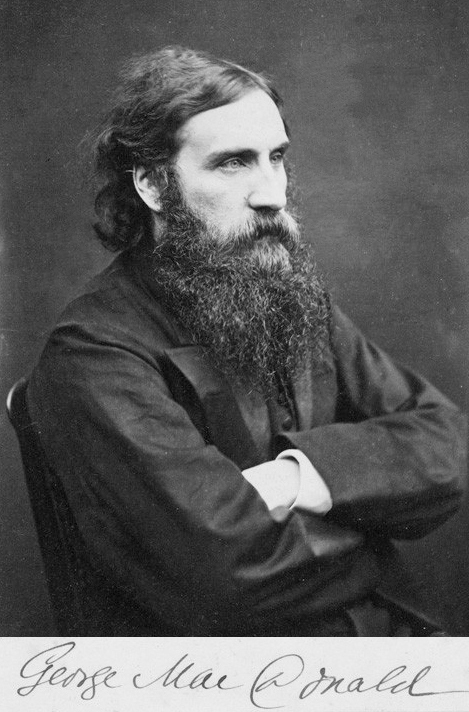
Quote by George MacDonald

“Shadow of me!” I said; “which art not me, but which representest thyself to me as me; here I may find a shadow of light which will devour thee, the shadow of darkness! Here I may find a blessing which will fall on thee as a curse, and damn thee to the blackness whence thou hast emerged unbidden.” I said this, stretched at length on the slope of the lawn above the river; and as the hope arose within me, the sun came forth from a light fleecy cloud that swept across his face; and hill and dale, and the great river winding on through the still mysterious forest, flashed back his rays as with a silent shout of joy; all nature lived and glowed; the very earth grew warm beneath me; a magnificent dragon-fly went past me like an arrow from a bow, and a whole concert of birds burst into choral song.”
― George MacDonald ,
from Phantastes
topics: hope
Be the first to react on this!



品牌集团


















© 2025 Bibleportal.com 版权所有.
George MacDonald was a Scottish author, poet, and Christian minister.
Known particularly for his poignant fairy tales and fantasy novels, George MacDonald inspired many authors, such as W. H. Auden, J. R. R. Tolkien, C. S. Lewis, E. Nesbit and Madeleine L'Engle. G. K. Chesterton cited The Princess and the Goblin as a book that had "made a difference to my whole existence."
Even Mark Twain, who initially disliked MacDonald, became friends with him, and there is some evidence that Twain was influenced by MacDonald.
MacDonald grew up influenced by his Congregational Church, with an atmosphere of Calvinism. But MacDonald never felt comfortable with some aspects of Calvinist doctrine; indeed, legend has it that when the doctrine of predestination was first explained to him, he burst into tears (although assured that he was one of the elect). Later novels, such as Robert Falconer and Lilith, show a distaste for the idea that God's electing love is limited to some and denied to others.