
Inspirational Quotes on Philosophy


“she does not suspect how much reason I have for deprecating all sympathy.”
“Something wonderful has happened to me. I was carried up into the seventh heaven. There all the gods sat assembled. By special grace I was granted the favor of a wish. "Will you," said Mercury, "have youth, or beauty, or power, or a long life, or the most beautiful maiden, or any of the other glories we have in the chest? Choose, but only one thing." For a moment I was at a loss. Then I addressed myself to the gods as follows: "Most honorable contemporaries, I choose this one thing, that I may always have the laugh on my side." Not one of the gods said a word, on the contrary, they all began to laugh. Hence, I concluded that my request was granted, and found that the gods knew how to express themselves with great taste; for it would hardly have been suitable for them to answer gravely: "It is granted thee.”
“It is a positive starting point for philosophy when Aristotle says that philosophy begins with wonder, not as in our day with doubt. Moreover the world will learn that the thing is not to begin with the negative, and the reason why it has succeeded up to the present is that it has never really given itself over to the negative, and so has never seriously done what it said. Its doubt is mere child's play.”

“If all the world were Christian, it might not matter if all the world were uneducated. But, as it is, a cultural life will exist outside the Church whether it exists inside or not. To be ignorant and simple now -- not to be able to meet the enemies on their own ground -- would be to throw down our weapons, and to betray our uneducated brethren who have, under God, no defense but us against the intellectual attacks of the heathen. Good philosophy must exist, if for no other reason, because bad philosophy needs to be answered. The cool intellect must work not only against cool intellect on the other side, but against the muddy heathen mysticisms which deny intellect altogether. Most of all, perhaps we need intimate knowledge of the past. Not that the past has any magic about it, but because we cannot study the future, and yet need something to set against the present, to remind us that periods and that much which seems certain to the uneducated is merely temporary fashion. A man who has lived in many place is not likely to be deceived by the local errors of his native village: the scholar has lived in many times and is therefore in some degree immune form the great cataract of nonsense that pours from the press and the microphone of his own age.”
― C.S. Lewis ,
from The Weight of Glory

“You do not admit the conceivability at all?' he queried. 'But why not? We admit the existence of electricity, of which we know nothing. Why should there not be some new force, still unknown to us, which...' 'When electricity was discovered,' Levin interrupted hurriedly, 'it was only the phenomenon that was discovered, and it was unknown from what it proceeded and what were its effects, and ages passed before its applications were conceived. But the spiritualists have begun with tables writing for them, and spirits appearing to them, and have only later started saying that it is an unknown force.' Vronsky listened attentively to Levin, as he always did listen, obviously interested in his words. 'Yes, but the spiritualists say we don't know at present what this force is, but there is a force, and these are the conditions in which it acts. Let the scientific men find out what the force consists in. Not, I don't see why there should not be a new force, if it...' 'Why, because with electricity,' Levin interrupted again, 'every time you rub tar against wool, a recognized phenomenon is manifested, but in this case it does not happen every time, and so it follows it is not a natural phenomenon.”
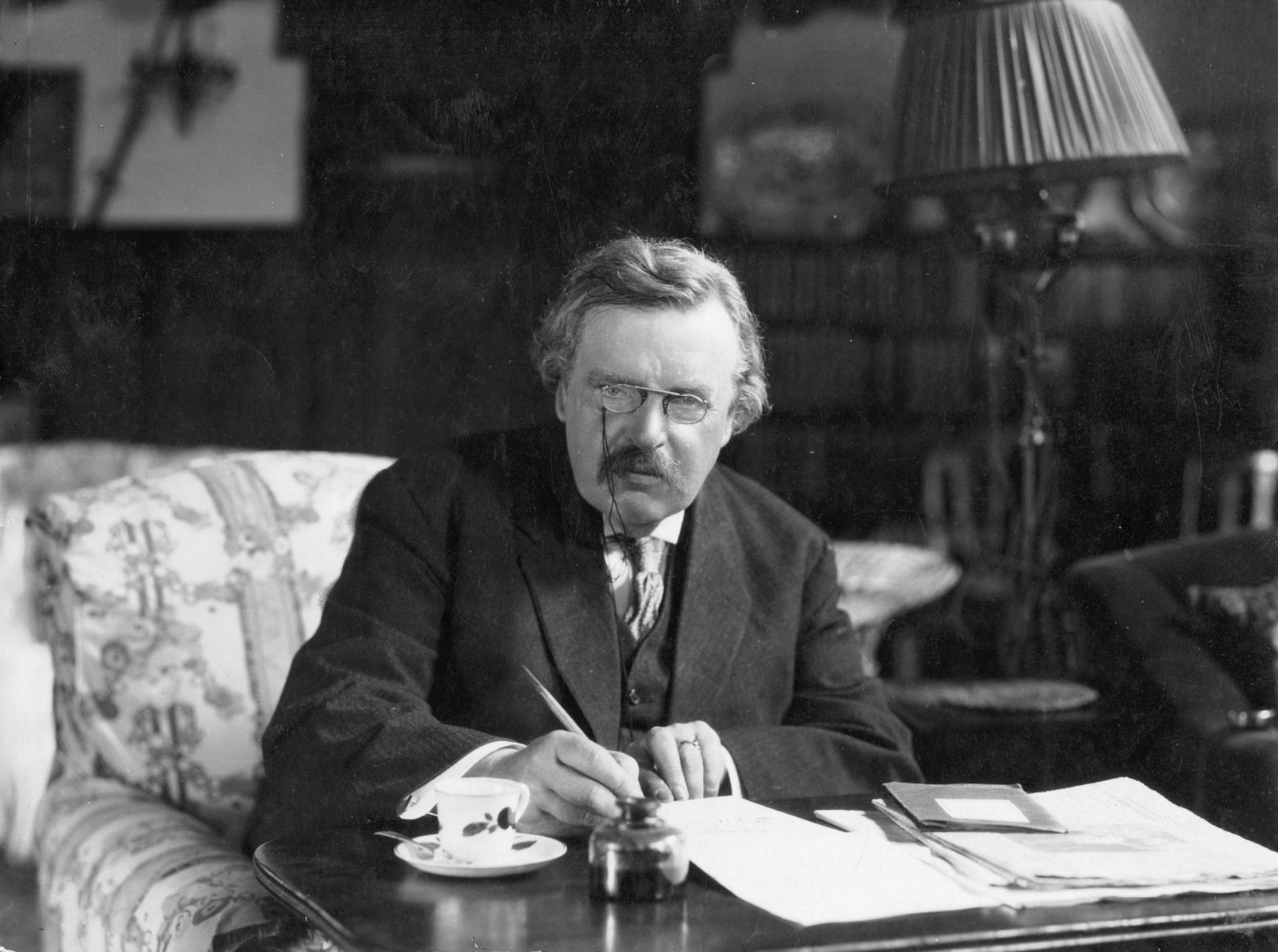
“The modern mind is merely a blank about the philosophy of toleration; and the average agnostic of recent times has really had no notion of what he meant by religious liberty and equality. He took his own ethics as self-evident and enforced them; such as decency or the error of the Adamite heresy. Then he was horribly shocked if he heard of anybody else, Moslem or Christian, taking his ethics as self-evident and enforcing them; such as reverence or the error of the Atheist heresy. And then he wound up by taking all this lop-sided illogical deadlock, of the unconscious meeting the unfamiliar, and called it the liberality of his own mind. Medieval men thought that if a social system was founded on a certain idea it must fight for that idea, whether it was as simple as Islam or as carefully balanced as Catholicism. Modern men really think the same thing, as is clear when communists attack their ideas of property. Only they do not think it so clearly, because they have not really thought out their idea of property.”
― G.K. Chesterton ,
“The present importance of the Book of Job cannot be expressed adequately even by saying that it is the most interesting of ancient books. We may almost say of the Book of Job that it is the most interesting of modern books. In truth, of course, neither of the two phrases covers the matter, because fundamental human religion and fundamental human irreligion are both at once old and new; philosophy is either eternal or it is not philosophy. The modern habit of saying, 'This is my opinion, but I may be wrong,' is entirely irrational. If I say that it may be wrong I say that is not my opinion. The modern habit of saying 'Every man has a different philosophy; this is my philosophy and its suits me'; the habit of saying this is mere weak-mindedness. A cosmic philosophy is not constructed to fit a man; a cosmic philosophy is constructed to fit a cosmos. A man can no more possess a private religion than he can possess a private sun and moon.”
― G.K. Chesterton ,
from The Book of Job

“Certainly my work is negative, destructive; but … only in relation to the unhuman, not to the human[.]”
“I find my data first in myself, not first in the poets. For if I did not find it in myself, I would not be able to find it in the poets.”
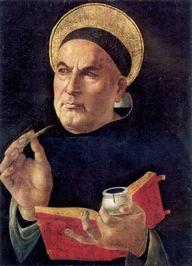
“God is not, like creatures, made up of parts. God is spirit, without bodily dimensions. Firstly, no body can cause change without itself being changed. Secondly, things with dimensions are potential of division. But the starting-point for all existence must be wholly real and not potential in any way: though things that get realized begin as potential, preceding them is the source of their realization which must already be real. Thirdly, living bodies are superior to other bodies; and what makes a body living is not the dimensions which make it a body (for then everything with dimensions would be living), but something more excellent like a soul. The most excellent existent of all then cannot be a body. So when the scriptures ascribe dimensions to God they are using spatial extension to symbolize the extent of God's power; just as they ascribe bodily organs to God as metaphors for their functions, and postures like sitting or standing to symbolize authority or strength.”
“How dreadful boredom is — how dreadfully boring; I know no stronger expression, no truer one, for like is recognized only by like… I lie prostrate, inert; the only thing I see is emptiness, the only thing I live on is emptiness, the only thing I move in is emptiness. I do not even suffer pain… Pain itself has lost its refreshment for me. If I were offered all the glories of the world or all the torments of the world, one would move me no more than the other; I would not turn over to the other side either to attain or to avoid. I am dying death. And what could divert me? Well, if I managed to see a faithfulness that withstood every ordeal, an enthusiasm that endured everything, a faith that moved mountains; if I were to become aware of an idea that joined the finite and the infinite.”
“What am I? The modest narrator who accompanies your triumphs; the dancer who supports you when you rise in your lovely grace; the branch upon which you rest a moment when you are tired of flying; the bass that interposes itself below the soprano’s fervour to let it climb even higher—what am I? I am the earthly gravity that keeps you on the ground. What am I, then? Body, mass, earth, dust and ashes.—You, my Cordelia, you are soul and spirit.” —Johannes the Seducer, from_Either/Or_”
“My love consumes me. Only my voice is left, a voice which has fallen in love with you whispers to you everywhere that I love you. Oh! Does it weary you to hear this voice? Everywhere it enfolds you; like an inexhaustible, shifting surround, I place my transparently reflected soul about your pure, deep being.” —Johannes the Seducer, from_Either/Or_”
“Courage is life's only measure.”


“But true philosophic demonstration will contribute to the profit not of the listeners' tongues, but of their minds. And, in my opinion, he who is solicitous about truth ought not to frame his language with artfulness and care, but only to try to express his meaning as he best can.”
“A “no” does not hide anything, but a yes can very easily become a deception, a self-deception; which of all difficulties is the most difficult to conquer. Ah, it is all too true that, “The road to hell is paved with good intentions.”
“But we are curious about the result, just as we are curious about the way a book turns out. We do not want to know anything about the anxiety, the distress, the paradox. We carry on an esthetic flirtation with the result. It arrives just as unexpectedly but also just as effortlessly as a prize in a lottery, and when we have heard the result, we have built ourselves up.”
“Battle day and night against the guile of oblivion...”
“Every individual, however original he may be, is still a child of God, of his age, of his nation, of his family and friends. Only thus is he truly himself. If in all this relativity he tries to be the absolute, then he becomes ridiculous.”



Group of Brands


















© 2026 Bibleportal.com All rights reserved.